Duplicating
Tour copied successfully!

Places (POIs) visited during this tour

Place #1
Distance: 0.00mi , Attraction : City square
Map Pin
Pl. de Sant Jaume, 8, 08002 Barcelona, Spain
POI 1 Tour Image
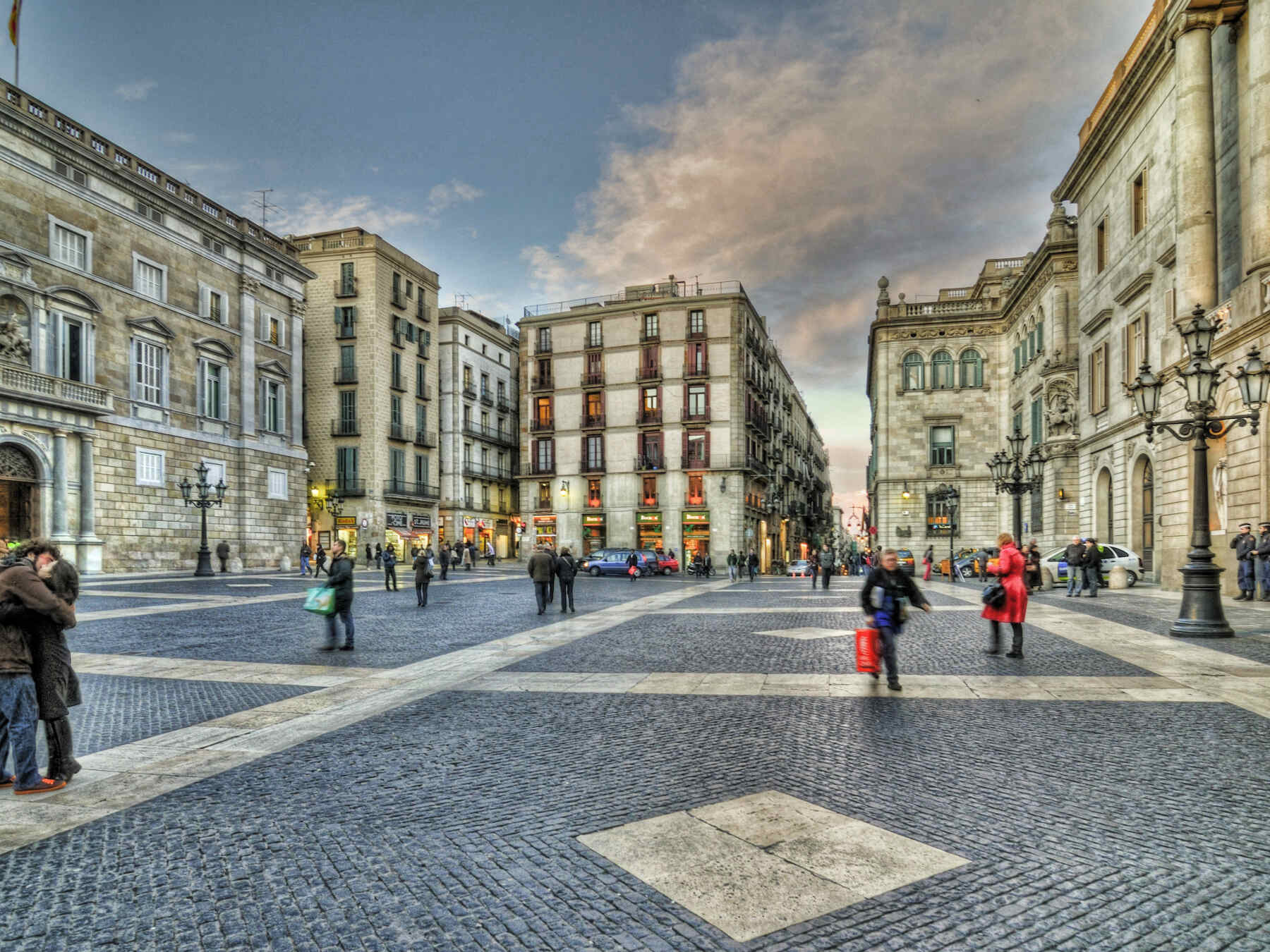
Plaça de Sant Jaume
Once again, welcome to Historic America & UCPlaces’ audio walking tour of Barcelona. We’re glad you could join us! I’m Aaron, your guide (but I also respond to professional history nerd). This is the part of the tour where I fit in my shameless plug for our websites (www.historicamerica.org & www.ucplaces.com) and I invite you to use #historicamericatours on social media while traveling alongside us today. Let’s begin the journey.

To begin, locate the street called Carrer del Bisbe which leads off the plaza to the northwest. Follow this street and as you do, begin looking upwards for a marble bridge connecting the two buildings on either side of the roadway.

  https://en.wikipedia.org/wiki/Pla%C3%A7a_Sant_Jaume
Place #2
Distance: 0.82mi , Attraction : Gothic bridge
Map Pin
C. del Bisbe, 1, 08002 Barcelona, Spain
POI 2 Tour Image
Pont del Bisbe
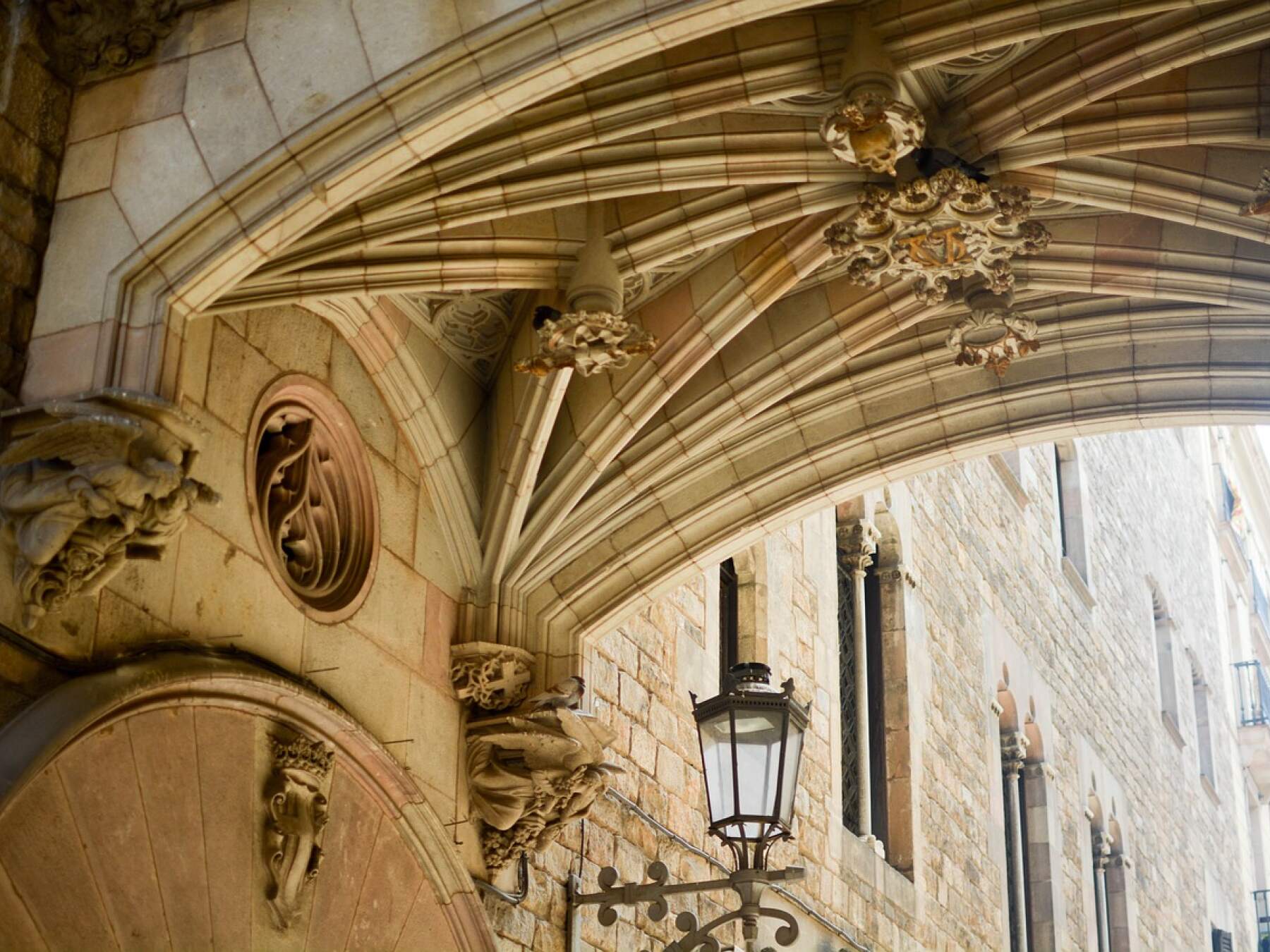
Look up - do you see that ornate bridge spanning the two buildings on either side of you? This is our first stop, called the Pont del Bisbe, or Bishop Bridge. This impressive marble structure is emblematic of Gothic architecture – in vogue from the late 12th to the 16th century. It has characteristic Gothic features, such as columns and pointed arches. However, it is a far more recent addition to the city than it may appear. The Pont del Bisbe was constructed in 1928!

It was built in preparation for the second world fair held in Barcelona, the 1929 Barcelona International Exposition. Twenty nations from all across Europe participated in the fair. Hosting the fair was a unique opportunity for Barcelona to showcase their modern industry, fascinating history, and rich culture. Urban development projects were sponsored all over the city, so that Barcelona’s best foot could be put forward. The exposition was originally planned for 1917, but was delayed due to the outbreak of WWI.

This delay meant that architects of all different styles and schools had additional time and opportunity to express themselves through urban development projects. Architect Joan Rubio y Bellver’s Pont del Bisbe was placed in the city’s Gothic Quarter, and reflects a growing movement in the 19th and 20th century to return to historic architectural styles from eras past. The Gothic Quarter (where you now stand) encompasses Barcelona's oldest neighborhoods. It houses important Medieval buildings, and has a layout typical of its age, with narrow, winding streets, periodically opening into large plazas. Walking through here is like stepping into a storybook land. Wouldn’t you agree?

Despite being known as the Gothic Quarter, the majority of the buildings in this particular neighborhood hail from the 19th and 20th centuries. This is because Barcelona undertook a number of revitalization projects starting in the 1800s, purposefully transforming the neighborhood from a somewhat dingy relic of the past into a bright and shiny tourist attraction. Nowadays, historians mourn this fact. However, the neighborhood still has tons of architectural interest, with many of its oldest buildings – such as the Barcelona Cathedral – remodeled in a distinctly Gothic style.

The Gothic Quarter even contains remnants from the Roman Empire. In the Imperial Period, from 31 BC to 476 AD, the land that is now Barcelona was known as the colony of Barcino. The colony was founded by Roman emperor Augustus between 15-10 BC. A fortification wall was built by the Romans during the 1st and 2nd century AD, the remains of which can still be found throughout the Gothic Quarter. But not everything has changed from ancient times — back then this region of Spain was known widely for its wine, and still is today. So make sure to grab a sangria at the end of our tour.

Returning to the Pont del Bisbe, its architect Joan Rubio i Bellver was intent on revitalizing Barcelona’s past with his 20th century work. He had expansive plans to “Gothic-ize” Barcelona, but the city council rejected many of his ideas. Infuriated, he placed a skull and dagger on the underside of the bridge to express his discontent. Legend has it that anyone who looks at the skull and dagger will be cursed; maybe avert your eyes when you walk under, just to be on the safe side. However, some say if you walk backwards under the bridge while looking at the skull, your wishes will be granted.

Read More

  https://barcelonalowdown.com/bishops-bridge/
Tour itinerary stops | Additional places you'll see on this self-guided tour

Map Pin Place 1 Plaça de Sant Jaume
Map Pin Place 2 Pont del Bisbe
Map Pin Place 3 Catedral de Barcelona
Map Pin Place 4 Placa de la Villa de Madrid
Map Pin Place 5 Avenida del Portal de I'Angel
Map Pin Place 6 Placa de Catalunya
Map Pin Place 7 Casa Batllo
Map Pin Place 8 Casa Mila
Map Pin Place 9 Casa de les Punxes
Map Pin Place 10 Palau Macaya
Map Pin Place 11 Placa de la Sagrada Familia
Map Pin Place 12 La Sagrada Familia


This is a premium tour, click below for complete access!

 
How to take a UCPlaces tour
Taking a UCPlaces tour is fun and easy.
Download the app (Android or iOS), purchase the tour (either here on the website, or from within the app).
That's it, you're ready to go!
When you want to start the tour, find the tour in the app (via a quick in-app search or by clicking the tour link received in your confirmation email) and click "Start Tour" (headphones recommended for best experience.)
* After purchasing a tour you will receive a purchase confirmation email including the tour link and instructions on how to take the tour, so you don't have to remember anything now.
How does the tour work?
UCPlaces acts as your personal tour guide, providing self-guided audio tours fully navigated within our app using GPS-based navigation. You won't need to switch between external navigation apps.
Whenever you approach a point of interest (POI) on the tour, our app will automatically play the relevant audio story at the right time and place.
If you start the tour before reaching the first POI, the app will navigate you to the starting point and then begin the tour.
How is this more convenient than a traditional tour?
UCPlaces offers an innovative and flexible way to explore exciting destinations on your terms.
Here are some key advantages over traditional tours:
  • No need to commit upfront or purchase in advance; buy a tour only when you're ready to go.
  • Walk at your own pace.
  • No waiting for groups; go on your schedule.
  • Take the tour in your preferred language.
  • Start, stop and continue the tour whenever you want.
  • Returning to the same destination? Take the tour again, and again, and again... And bring a friend!
  • Enjoy preferred prices.

What's included?
  • A self-guided audio tour taken via the UCPlaces app [Android / iOS (iPhone) / Apple CarPlay].
  • Tour route map and in-app GPS navigation (via the UCPlaces app).
  • Audio stories for places visited during the tour.
  • Apple CarPlay connection (for iOS users); for a seamless driving tour experience.
What's NOT included?
  • Earphones (highly recommended).
  • Smartphone.
  • Any kind of transportation (including tickets and passes).
  • Tickets to the attractions on your tour.
  • Food and drinks
  • Physical tour guide.

Have any questions about this tour? Or a general travel / self-guided tours question? That's completely natural

+ How long does this tour take?
Most travelers complete this tour in approximately 1 to 1.5 hours, depending on pace, time spent at each stop, and optional detours. Having said that, please remember that self-guided tours are extremly flexible (you can start, pause, continue anytime) and everyone has their own pace.
+ What does this tour include?
This self-guided walking tour includes 12 stops, covering top attractions such as Plaça de Sant Jaume, Pont del Bisbe, Catedral de Barcelona, Placa de la Villa de Madrid, Avenida del Portal de I'Angel.
+ Where does the tour start?
The tour starts at Plaça de Sant Jaume (Address: Pl. de Sant Jaume, 8, 08002 Barcelona, Spain). You can begin the tour there or join from any stop along the route.
+ What type of tour is this?
This is a self-guided walking tour designed to be completed on foot through walkable areas and city highlights.
+ Can I do this tour at my own pace?
Yes, this is a self-guided walking tour, so you can start anytime and explore at your own pace. You can pause, skip stops, or spend more time at places that interest you. You can even split it into multiple days. Explore however feels right for you.
+ Is this a walkable tour?
Yes, this tour is fully walkable and designed to follow a comfortable route through pedestrian-friendly areas.
+ Do I need anything in order to take the tour?
There is one thing that you need - A mobile phone (with the UCPlaces app installed and active location services, and a cellular data plan with a decent signal for downloading the tour) and comfortable walking shoes! But here are some recommendations for a great experience: 1. Make sure your phone is fully charged and bring a mobile charger/battery. 2. Bring earphones for the best experience. 3. Bring a bottle of water and dress appropriately according to the weather forecast.
+ How will I navigate from point to point during the tour?
The tour uses GPS-based navigation through the UCPlaces app, with automatic audio playback and step-by-step directions between stops. Just follow the route (cross streets carefully using crosswalks) and listen to the audio guide. Use the resume feature to continue the from where you recently stopped (or closed the app). Easily skip or go back to stops.
+ Is this tour suitable for families or groups?
Yes, self-guided tours are ideal for families and small groups, allowing everyone to explore comfortably without being tied to a fixed schedule.
+ What makes a self-guided tour better than a guided tour?
Self-guided tours are more flexible, affordable, and personalized. You can avoid crowds, choose your pace, and focus on the stops that interest you most.
+ I installed the app and it's now asking for GPS and media access permissions, why?
The app is your tour-guide, it needs to know where you are located on the map to be able to trigger the points of interest. It also needs access to audio and media files to provide you with this experience.
+ What happens if there are unexpected roadblocks or navigation issues?
We have been working hard to deliver a great experience. Though you may run into unexpected obstacles (the world is constantly changing), our app has multiple features and mechanisms in place to help you overcome them, including: AI assistance, force play an audio if you can't reach the stop, skip or return to stops, automatic rerouting and more.
+ Can I take the tour in my language?
Though all of our tours are primarily in English, many tours are muyltilingual (including: Spanish, German, Portuguese, French, Japanese, Hebrew, French, Arabic and more...). The tour language options depend on the specific tour - You can easily check which languages are available in the tour screen!