

 Walking (OffRoad) tour

 ) to use Force Play, Skip, and Back, for full flexibility.
Place 1
Torpedo Factory Recommended starting point
Distance: 0.07 mi · Attraction: Art Center 105 N Union St, Alexandria, VA 22314, USA
0:00
Welcome to Historic America & UCPlaces’ walking tour of Old Town Alexandria, Virginia. I’m Rachel, Professional History Nerd, ice cream lover, and your guide for today. Together we’ll visit must-see historic sites and must-taste ice cream shops, learning about the history and culture of this little city, with big charm.
Our tour begins here on the idyllic Potomac River waterfront. You should be standing on the dockside of a building with red awnings, a red stripe across the top of the facade, and a small smokestack. This is the Torpedo Factory Art Center. And yes, you guessed it, this building was an actual torpedo factory! It was constructed immediately after WWI and manufactured Allied torpedoes during WWII. After the Second World War, it became a storage center, housing congressional records and overflow Smithsonian artifacts. In 1974, it became the Torpedo Factory Art Center, boasting the nation’s largest collection of publicly accessible working artist studios. More than 165 artists create and exhibit their work inside, making the building, and Alexandria itself, an important artistic epicenter for the region.
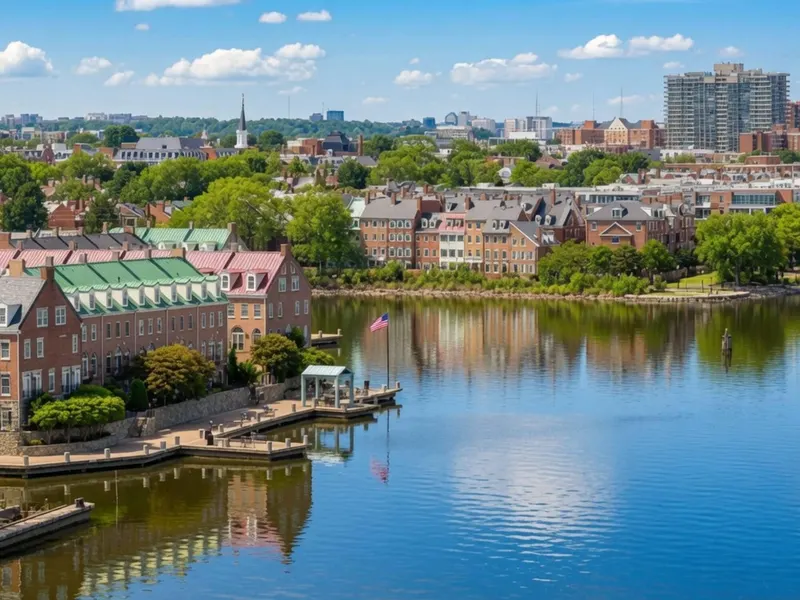
Now let's have a look at the waterfront itself. Turn around and face the river. The Potomac creates a boundary here, dividing the District of Columbia and Virginia. Looking to your left, you'll see water taxis and sightseeing boats. To your right is a large swath of public green space, perfect for outdoor recreation and relaxation, and often home to public art installations in recent years. Don’t let the well manicured grass and joggers with lattes fool you, this riverfront port wasn’t always a picturesque place to kick back and pass the time.
The shoreline has been a useful and popular spot for centuries. Just upriver, the Potomac tumbles over a series of cataracts known as Great Falls, its last obstacle before spilling into the Chesapeake Bay. These falls form a barrier to fish traveling upstream to spawn each year, which makes this a prime spot for great fishing. Indigenous peoples inhabited the region going back over 13,000 years, up until the disease and displacement of European colonization.
When Europeans arrived in this region in the 17th Century, this location was quickly identified as a valuable port, and it would prove a crucial component of the colony’s financial success. Small cash crop farms began to dot the region and soon Alexandria’s first tobacco warehouse was built here in 1732. By the city’s official founding in 1749, it was well on the way to becoming a manufacturing mecca. By 1779, Alexandria was important enough to be declared an official point of entry, meaning foreign ships could dock here and undergo inspections. By the 1790’s, Alexandria was one of the largest ports in the new United States. This port city on the Potomac developed outward from right here, moving farther and farther west through the centuries that followed. In the West End, Commerce Street connected Duke and King streets at an angle, to facilitate the passage of farm wagons from nearby farms, to market locally, and to waiting ships.
The port also became the epicenter of the domestic slave trade. The location was ideal for purchasing enslaved individuals from nearby plantations, and making sales that sent large groups to the major markets in the Deep South. By way of forced march, or on tightly packed ships that left from this port, thousands of people were sold to work in the cotton fields and sugar plantations that powered the American economy. The decades between ratification of the Constitution and the Civil War saw approximately one million enslaved people relocated from here in the Mid-Atlantic and upper South, to the Lower South. In the story of America’s original sin, some of its most horrific chapters were written right here. From the time of colonization this port was a place of business, and black bodies were a commodity.
In the life of a city, geography and climate are destiny. And so, as you take in the views of this waterfront it should come as no surprise that Alexandria was destined to become, at least for a time, a major seaport.
When you’re ready, leave the waterfront behind you and use the built in navigation to make your way to King Street.
https://www.nps.gov/gwmp/learn/historyculture/alexandria.htm