

Montreal's Best: Self-Guided Driving Tour of Iconic Landmarks
Montreal: Self-Guided Driving Audio Tour of Iconic Landmarks incl. Mount Royal
About this English self-guided 2h:26m driving tour in Montreal
Welcome to Montreal, Canada's vibrant French-speaking metropolis, where European charm meets North American energy.
Over the next few hours, we'll take you on a journey through nearly four centuries of history, culture, architecture, and innovation. From the cobblestone streets of Old Montreal to the breathtaking views atop Mount Royal, from the Olympic Park and Formula 1 circuit to lively neighborhoods like Outremont, Mile End, and Little Italy, you'll experience the many sides of this remarkable city.
Along the way, your GPS will guide you turn by turn while I'll share fascinating stories, local history, fun facts, and hidden gems. There are plenty of opportunities to stop, explore, take photos, or simply enjoy the scenery at your own pace. Remember, you can pause the tour at any time and resume later, or restart from any point of interest whenever it's most convenient.
Please drive safely, obey all traffic laws, and let the audio play naturally. If you happen to miss a turn or encounter a road closure, don't worry—the route will automatically adjust to get you back on track.
Whether this is your first visit or you've been here many times before, I hope you'll discover something new about this extraordinary city.
So buckle up, relax, and let's begin exploring Montreal together with UCPlaces!
Top landmarks on this tour
 Saint Joseph's Oratory of Mount Royal
- Kondiaronk Belvedere
- Place Ville Marie
- Mary, Queen of the World Cathedral
- McGill University
- Jean-Talon Market
- 1For the best experience, begin at the tour's recommended starting point and follow the stops in order.
- 2Want to start somewhere else? Simply use Start At on the tour screen, before tapping Start Tour, to begin from any stop.
- 3Need to detour or skip a stop along the way? Tap Tour Assistant (
![UCPlaces AI Bot Icon]() ) to use Force Play, Skip, and Back, for full flexibility.
 ) to use Force Play, Skip, and Back, for full flexibility.
Route Preview
- Category
- Language
- Mode
- Region
- Country
- City

Places (POIs) visited during this tour
1205 Rue St-Alexandre, Montreal, QC H3B 3H5, Canada

As you drive through these bustling streets, you'll quickly notice that Montreal feels different from most North American cities. The elegant stone buildings, sidewalk cafés, and frequent French signs often make visitors feel as though they've crossed the Atlantic into Europe.
Montreal is the largest French-speaking city in the Americas and one of the world's most bilingual metropolitan areas. While French is the official language of Quebec and the language you'll see on street signs and hear most often, English is also widely spoken, creating a unique blend of cultures that has shaped the city's identity for centuries.
The city itself sits on an island between the mighty Saint Lawrence and Ottawa Rivers. It was founded by French settlers in 1642 as Ville-Marie, a small missionary colony. Over the centuries, Montreal grew into one of North America's most important ports and commercial centers, welcoming immigrants from around the world who added their own traditions, cuisines, and neighborhoods to its rich cultural tapestry.
Today, more than four million people call the greater Montreal area home. It's a city celebrated for its world-class festivals, renowned restaurants, thriving arts scene, and passion for sports—especially hockey, which many locals consider more than just a game.
As we explore, you'll discover that every neighborhood has its own personality. From sleek skyscrapers and historic churches to lively markets, Olympic landmarks, and charming waterfront streets, Montreal is a city of remarkable contrasts. So settle in and enjoy the drive as we begin discovering one of North America's most captivating destinations.
Read More
Metcalfe / René-Lévesque, Montréal, QC H3B 0C1, Canada
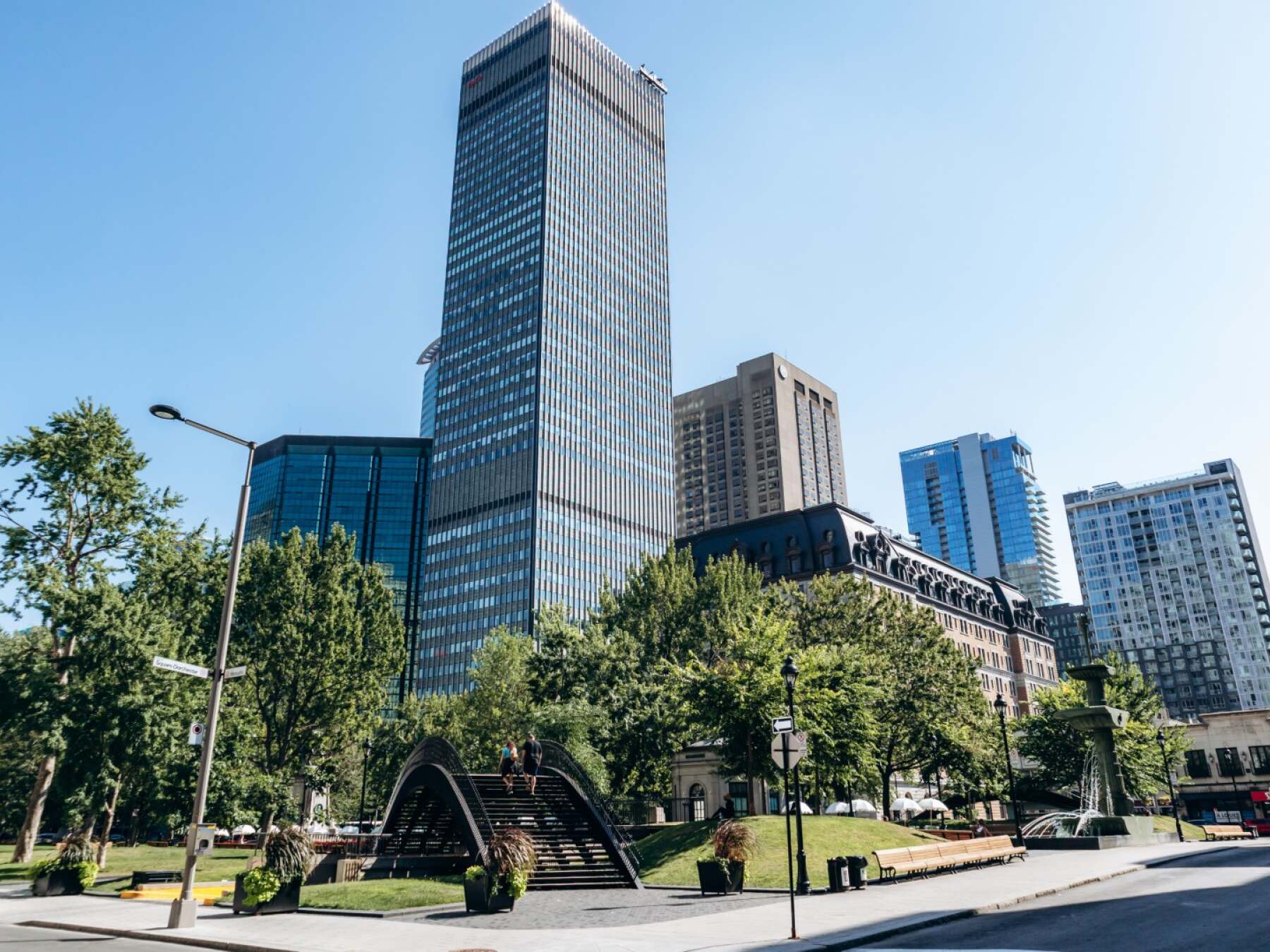
Created in the 19th century, the square has long served as a green oasis in the heart of the bustling downtown district. Surrounded by historic office buildings, hotels, and churches, it has witnessed Montreal's transformation from a colonial city into Canada's economic powerhouse.
As you pass by, notice the mature trees, carefully landscaped gardens, and impressive monuments scattered throughout the park. One of the most prominent is the statue of Sir Wilfrid Laurier, Canada's seventh Prime Minister and the country's first French Canadian to hold the office. Other monuments honor influential figures who helped shape both Montreal and Canada.
The square was originally named after Lord Dorchester, the British governor of Quebec following the American Revolution. In recent years, the city restored its historic appearance, preserving many of its original pathways, fountains, and Victorian-era character.
Together with the neighboring Place du Canada just across the street, Dorchester Square provides a welcome escape from the surrounding skyscrapers. Office workers gather here during lunch, visitors pause to relax, and throughout the year the park hosts public events and seasonal celebrations.
Read More
Place 1
Welcome to Downtown Montreal
Place 2
Dorchester Square
Place 3
Boulevard René-Lévesque
Place 4
The Golden Square Mile - Historic Mansions District
Place 5
Maude Abbott Museum
Place 6
Le Nouveau Vic
Place 7
The Peel Steps – Gateway to Mount Royal
Place 8
Outremont – Maplewood Avenue
Place 9
Université de Montréal
Place 10
Fun Facts About Montreal
Place 11
Parc Outremont & Saint-Viateur Avenue
Place 12
Mile End – Montreal's Bohemian & Trendy Hub
Place 13
Hochelaga-Maisonneuve – From Industry to Innovation
Place 14
Jacques Cartier Bridge – Gateway to Montreal
Place 15
Circuit Gilles Villeneuve – Drive an F1 Track
Place 16
Crossing Back to Montreal
Place 17
Habitat 67 – A Revolutionary Housing Experiment
Place 18
Old Port of Montreal – Where the City Began
Place 19
Old Montreal – A Journey Through Time
Place 20
Place d'Armes – The Heart of Historic Montreal
Place 21
Montreal's Historic Civic Center
Place 22
Clock Tower – The Perfect Montreal Finale
Place 23
Saint Joseph's Oratory of Mount Royal
Place 24
Kondiaronk Belvedere - Montreal's most iconic viewpoint
Place 25
Place Ville Marie - Iconic Cross-Shaped Tower
Place 26
Mary, Queen of the World Cathedral
Place 27
McGill University – One of Canada's Finest
Place 28
Jean-Talon Market – Montreal's Culinary Heart
Place 29
Olympic Park – Home of the 1976 Olympic Games
Place 30
Montreal Biosphere – Expo 67 Icon
Place 31
Notre-Dame-des-Neiges Cemetery
Place 32
Little Italy – A Taste of Italy in Montreal