

Self-Guided GPS Audio Bicycle Tour of Paris, France - Main Sites & History
About this English self-guided n/a bicycle tour in Paris
Welcome to Historic America & UCPlaces' audio bicycling tour of revolutionary Paris! I'm your tour guide, Aaron Killian. Today we'll be biking through the revolutionary landscape of the city of light! We will wend our way through grand plazas, admire towering columns, enjoy the city's magnificent landmarks, and then – look beyond it all – to uncover the bloody, boisterous, world changing historical events which took place on this grand stage.
We can't wait to share the revolutionary story of Paris with you. Vive la revolution!
To get started, make your way to the Velib Metropole bike sharing station on the southern edge of the Place de la Bastille just off the Boulevard Bordon. It should be easy to find because it's a short walk from the metro and close by the public toilets. How convenient! I'll see you there in a flush to begin our ride.
- 1For the best experience, begin at the tour's recommended starting point and follow the stops in order.
- 2Want to start somewhere else? Simply use Start At on the tour screen, before tapping Start Tour, to begin from any stop.
- 3Need to detour or skip a stop along the way? Tap Tour Assistant (
![UCPlaces AI Bot Icon]() ) to use Force Play, Skip, and Back, for full flexibility.
) to use Force Play, Skip, and Back, for full flexibility.
 ) to use Force Play, Skip, and Back, for full flexibility.
Route Preview

Places (POIs) visited during this tour

Bastille, Paris, France

This is the part of the tour where I fit in my shameless plug for our websites (www.historicamerica.org & www.ucplaces.com) and invite you to use #historicamericatours on social media while traveling alongside us today. Let's begin the journey.
First thing's first - unless you brought a bike with you, you're gonna have to rent one at this Velib station. Don't worry. It's super easy because there are only a couple of steps in the rental process. First, you need to choose and purchase an access pass using the multilingual interactive panel on site OR utilize the downloadable Velib app on your smartphone. Then select the bike you want to ride, key in your code, and … you’re off!
You'l likely have the choice between a regular OR electric bike. It's up to you.
I suggest you get an all day or multi-day pass. During the course of our tour, this pass will give you the flexibility to dock your bike at any of the many stations along our route. You are free at any time to explore the sites more thoroughly on foot - or maybe you'd like to take a break to grab an espresso or snack. Then - whenever you're ready - your day pass allows you to unlock another bike and continue our tour. In essence you can make this ride as long or short as you like. I'm here to guide you from point to point and give you some great stories along the way.
Now that I’ve explained myself, get a bike in hand, and proceed to the northern edge of the Place de la Bastille to trigger the first true point of interest on tour.
Oh - one final note - don't worry if there aren't enough bikes available at this Velib station. There are other stations nearby. Just use your phone to locate them.
Read More
Bastille, Paris, France
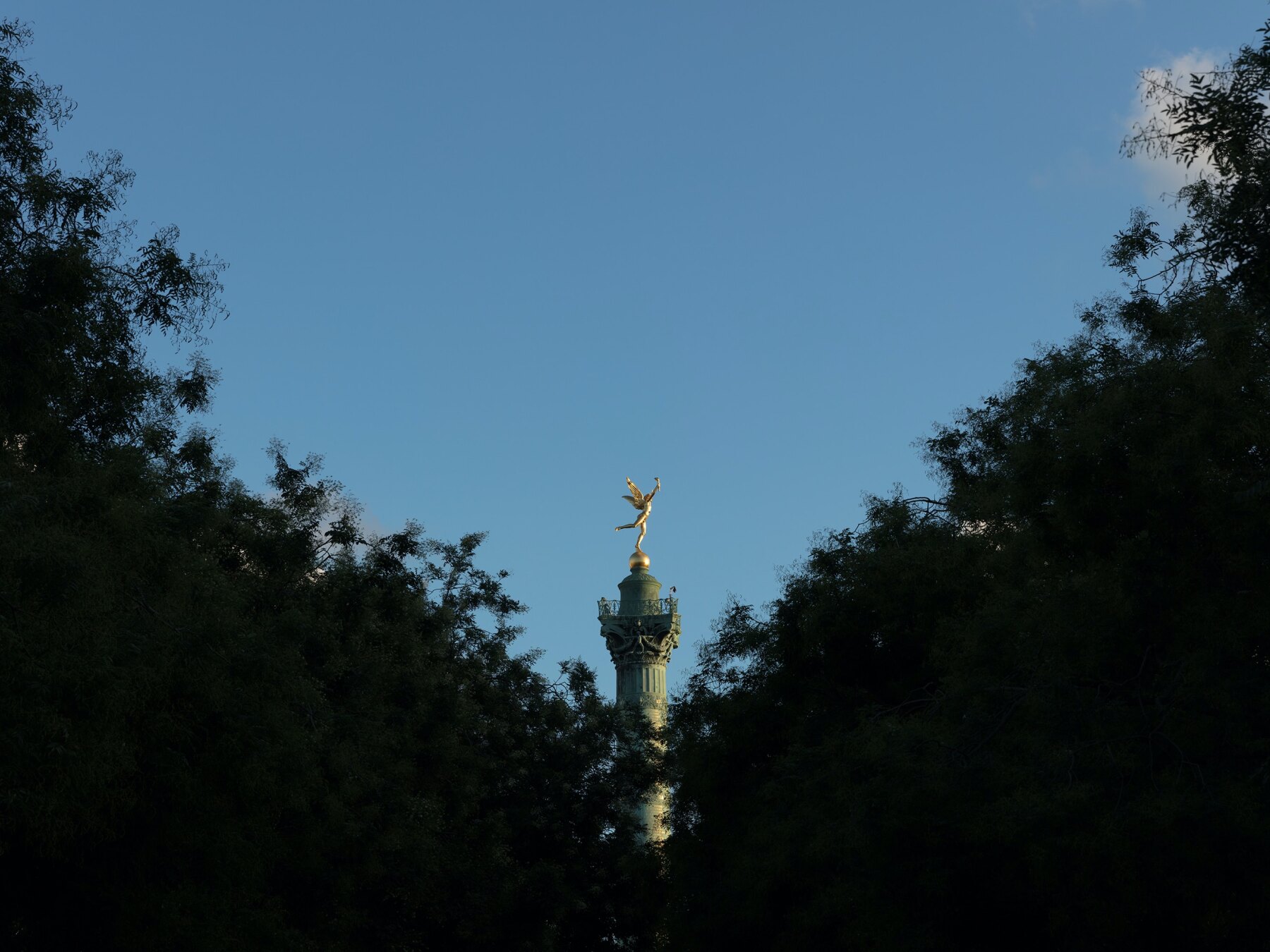
The column is over 150 feet high and topped with the shining, gilded representation of liberty. The names of those who died during the Revolution of 1830 are engraved on the column in gold lettering.
Now, I know what you’re thinking. “How many revolutions has France had, anyway?”
Well first, let’s define our terms. In the context of this tour, a revolution is when a country’s sitting government is forcibly overthrown and a new governmental system is implemented. The generally accepted answer to the “how many revolutions in France" question is 3; a trio of major revolutions in 1789, 1830, and 1848 interspersed with a number of uprisings and violent seizures of power which occurred throughout the 1800s. The saga of revolutionary France is fascinating, interconnected and very complex. Honestly, if we were to visit every revolution-related site in Paris, it’d take days – and your legs would give out from all the peddling. On this tour, we’ll stick to the highlights and give you a good overview. Let’s start at the beginning with the storming of the Bastille.
On July 14th, 1789 long simmering tensions boiled over in a fit violence as hundreds of French civilians – fed up with the rule of the Bourbon monarchy — became revolutionaries and stormed the Bastille fortress which stood on this very spot. The event was the beginning of the revolutionary era of French history.
Although originally built to protect the city of Paris from foreign invasion, by the time of Louis XVI the Bastille was a prison for political dissidents and a symbol of the French monarchy’s oppression. It was an imposing building — see if you can envision it.
Eight rugged stone towers linked by curtain walls created a stout castle approximately 220 feet long, 120 feet thick, and 80 feet high. Now envision that same castle being overwhelmed by a churning mob of angry Parisians wielding muskets, swords and an assortment of cruel, makeshift weapons. Swarming the fortress’s outer courtyard, the rioters forced open the prison drawbridge amidst a hail of bullets fired at them from the defending garrison. Eventually the revolutionaries compelled the defenders to surrender. Shortly thereafter, they cut off the head of the garrison’s commander and paraded it around the city on a stick. Over a hundred Frenchmen died. Their eyes stung by smoke, their ears ringing with gunfire and the sound of angry men, the smell of powder in their nostrils and the metallic taste of blood in their mouths.
And this is just the first stop on our tour!
The storming of the Bastille is generally regarded as the beginning of the Revolution of 1789 – the granddaddy of French Revolutions – and the date, July 14th 1789 – has ever after been commemorated as a national holiday, Bastille Day.
To get to our next stop, take the Rue de Rivoli westward toward the Hotel DeVille. I’ll join you along the way.
Read More
Place 1
Vive le Revolution!
Place 2
Beginning of the Revolution
Place 3
Growing Tension
Place 4
Revolutionary Struggles
Place 5
Headquarters of Revolution
Place 6
Directions
Place 7
Directions
Place 8
Directions
Place 9
Prison of the Revolution
Place 10
Directions
Place 11
Temple of the Revolution
Place 12
La Marseilles
Place 13
Burial Ground of Revolution
Place 14
Directions
Place 15
Directions
Place 16
Directions
Place 17
Directions
Place 18
Directions
Place 19
Cafe of Revolution
Place 20
Directions
Place 21
Directions
Place 22
Directions
Place 23
Directions
Place 24
Directions
Place 25
The Louvre
Place 26
Directions
Place 27
Palace of Revolution
Place 28
Directions
Place 29
Directions
Place 30
Directions
Place 31
Pillar of Revolution
Place 32
Directions
Place 33
Garden of Revolution
Place 34
Directions
Place 35
Directions
Place 36
Execution Site of Revolution