

Porto, Portugal: Self-Guided Walking Tour of Clérigos, São Bento & the Ribeira Waterfront
About this English self-guided 1h:10m walking tour in Porto
Welcome to Porto, and welcome to one of the most rewarding walks in all of Europe.
Over the next ninety minutes to two hours, we will travel downhill through eight centuries of history, from the tiled churches on the city's high western edge all the way to the iron bridge that spans the Douro River.
This tour is for curious travelers, first-time visitors, and anyone who wants to understand Porto rather than simply photograph it.
Our theme is how a stubborn merchant city built itself on a granite slope, and how faith, trade, wine, and the river shaped every street you will walk.
Along the way you will see a church wall covered entirely in blue and white tiles, the bookshop the whole world queues for, and the Baroque tower that became the symbol of the city.
You will stand on a quiet terrace with one of the finest free views in Porto, walk through the forgotten medieval Jewish quarter, and step into a railway station decorated with some twenty thousand hand-painted tiles.
Then we climb to the fortress-like cathedral where the parents of Henry the Navigator were married, descend past the merchants' palace and a church glowing with gold, and finish on the riverfront at the Dom Luís the First bridge.
A quick, friendly word about the terrain.
Locals like to say that Porto is a staircase with a river at the bottom, and that is part of its charm.
The walk is mostly downhill, but there are two short climbs and several historic stairways.
The granite cobbles can be uneven, so comfortable shoes are your best companion, and you can pause the audio whenever you like.
Many of the places we pass have interiors you can visit, but this tour works perfectly from the outside, so treat every door as an invitation rather than an obligation.
The narration will begin automatically as you reach each stop.
Look up often, because in Porto the best details are rarely at eye level.
Our first stop is just ahead, on Rua do Carmo, where a wall of blue tiles is waiting to stop you in your tracks.
Let's begin.
Top landmarks on this tour
 Livraria Lello
- Dom Luís I Bridge
- Torre dos Clérigos
- Sé do Porto
- São Bento Station
- Igreja do Carmo
- 1For the best experience, begin at the tour's recommended starting point and follow the stops in order.
- 2Want to start somewhere else? Simply use Start At on the tour screen, before tapping Start Tour, to begin from any stop.
- 3Need to detour or skip a stop along the way? Tap Tour Assistant (
![UCPlaces AI Bot Icon]() ) to use Force Play, Skip, and Back, for full flexibility.
 ) to use Force Play, Skip, and Back, for full flexibility.
Route Preview
- Category
- Language
- Mode

Places (POIs) visited during this tour
Praça de Gomes Teixeira 5, 4050-456 Porto, Portugal
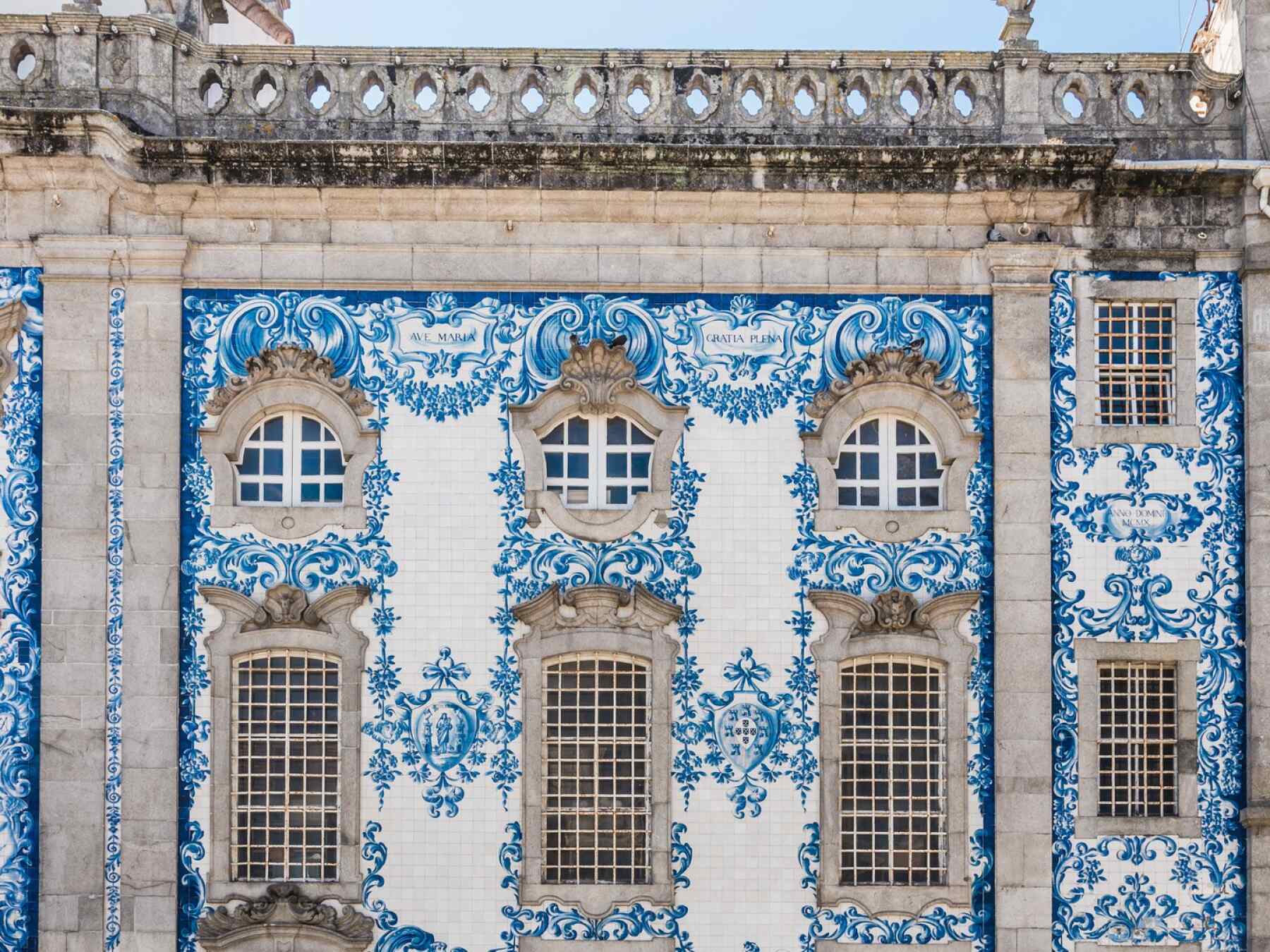
This is the side of the Igreja do Carmo, and almost every inch of it is covered in blue and white azulejos, the glazed tiles that have become Porto's signature.
The church itself is a Baroque building from the second half of the eighteenth century, but the tiles came much later, in 1912.
They were designed by the artist Silvestro Silvestri and fired across the river in Vila Nova de Gaia.
The panels tell the story of the Carmelite order, which traces its origins to hermits living on Mount Carmel in the Holy Land, and of the monastic life that followed.
The word azulejo, by the way, does not come from azul, the Portuguese word for blue.
It comes from an Arabic term for a small polished stone, a reminder of the Moorish roots of this art.
Now here is the secret most people walk straight past.
Step back and look at the front of the building, and you will notice that this is not one church but two, standing side by side.
On the left is the older Carmelitas church, built for Carmelite nuns, and on the right is the Carmo church, built for the Carmelite friars.
Tradition held that two churches should never share a wall, so the builders left a gap between them.
And inside that gap they built a house.
Look for the narrow green door and window between the two façades.
That is the Casa Escondida, the hidden house, barely more than a metre wide, squeezed between two churches.
Popular stories say it was there to keep the nuns and the monks apart, and remarkably, people actually lived in this sliver of a home into the 1980s.
Today you can sometimes visit it from inside the church.
Keep walking toward the open square just ahead, where four stone lions are waiting.
Read More
Praça de Gomes Teixeira 10, 4050-161 Porto, Portugal
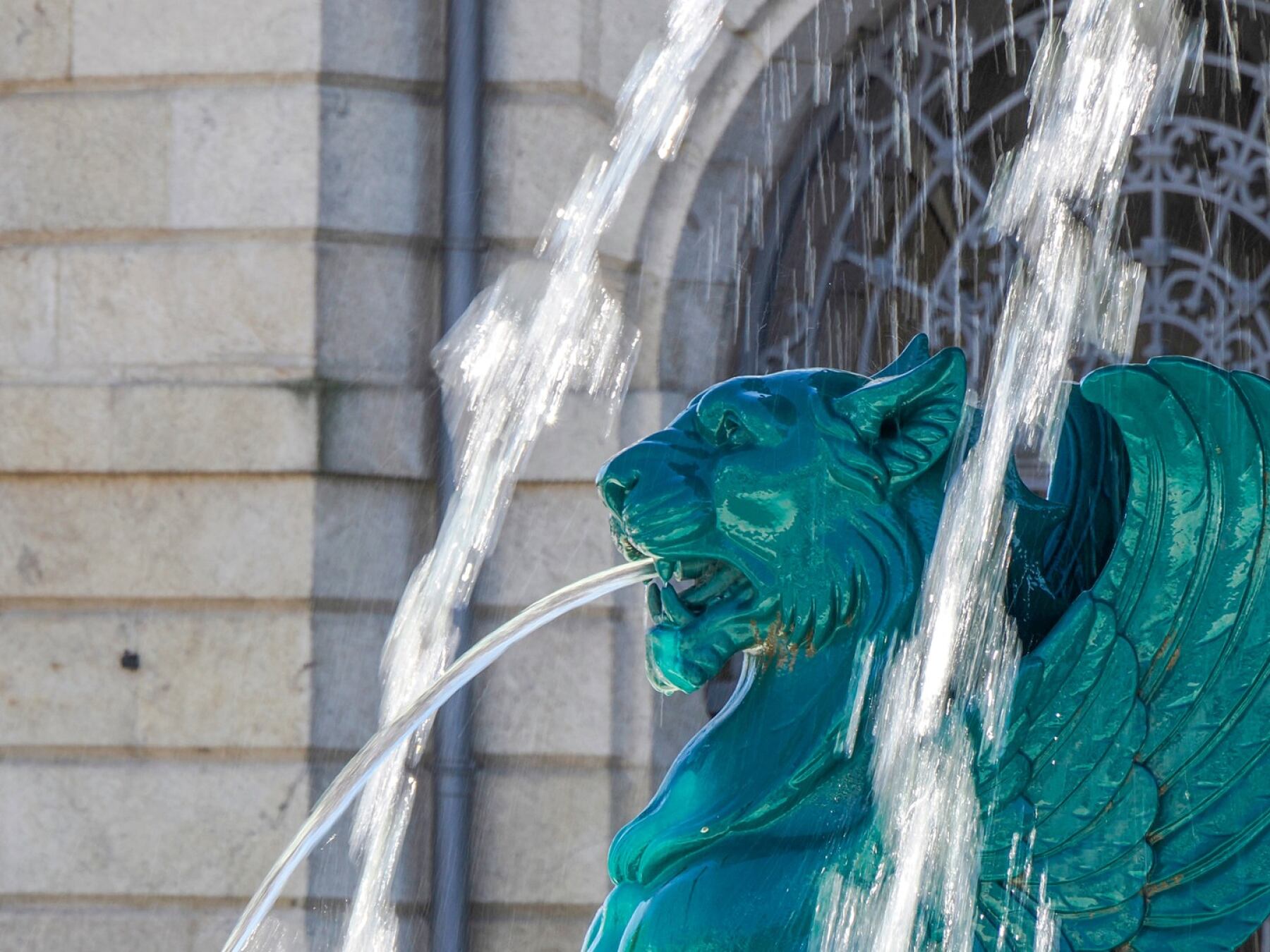
This is the Fonte dos Leões, the Lions Fountain, and it has stood here since the late nineteenth century, when Porto was busy modernising its public spaces with iron, water, and civic pride.
The cast-iron fountain was made abroad and shipped here, a sign of how international this trading city had become.
Locals simply call this place the lions square, and it is one of the classic meeting points of the city.
Now turn your attention to the grand neoclassical building facing the square.
This is the Rectory of the University of Porto, and its stately columns and long façade are a world away from the tile-covered Baroque churches you just admired.
The building was begun in the early nineteenth century, originally for the city's polytechnic school, and the university itself was founded in 1911, after Portugal became a republic.
You may notice students around here wearing long black capes.
These traditional academic gowns are part of Portuguese university life, and you will see them especially during festivities when first-year students are welcomed.
That flowing black cape has become linked, in visitors' minds, to a certain young wizard.
Hold that thought, because the most famous building on this street is just around the corner, and its story is wrapped in a myth we are about to gently untangle.
Before you leave the square, take one more look at the slope around you.
We are standing close to the highest point of this walk.
From here on, the city will gradually tip us downhill toward the river, with a few surprises along the way.
Continue along Rua das Carmelitas, and watch for a white façade with a crowd gathered in front of it.
Read More
Place 1
Igreja do Carmo: The Tile Wall Hiding a House Between Two Churches
Place 2
Fonte dos Leões: Four Lions at the Top of the City
Place 3
Livraria Lello: The World's Most Famous Bookshop (and the Myth Behind It)
Place 4
Torre dos Clérigos: Nasoni's Tower and His Unmarked Grave
Place 5
Porta do Olival: Porto's Lost Jewish Quarter and a Hidden Torah Ark
Place 6
Miradouro da Vitória: The Quiet Wall with the Biggest View
Place 7
Escadas da Vitória: Down the Old Synagogue Stairs
Place 8
Rua das Flores & Misericórdia: A Royal Street Cut Through a Bishop's Garden
Place 9
São Bento Station: 20,000 Tiles Where a Convent Once Stood
Place 10
Climb to the Sé: The Windy Rock Where Portugal Got Its Name
Place 11
Sé do Porto: The Fortress Cathedral of a History-Changing Wedding
Place 12
Guerra Junqueiro House and the Cathedral Treasury
Place 13
Monumento ao Infante Dom Henrique: Prince Henry the Navigator
Place 14
Palácio da Bolsa: The Merchants' Palace Built on Siege Ashes
Place 15
Igreja de São Francisco: A Plain Gothic Shell Hiding a Sea of Gold
Place 16
Casa do Infante: The Customs House Where Henry the Navigator Was Born
Place 17
Praça da Ribeira & Alminhas da Ponte: Postcard Porto and Its Darkest Day
Place 18
Dom Luís I Bridge: Eiffel's Partner and the Grand Finale