

Krakow Self-Guided (GPS) Audio Walking Tour, Poland - Old Town Vibes, Main Sites, Castles & Churches Galore
About this English self-guided 1h:35m walking tour in Kraków
Hello and welcome to this UCPlaces tour of Kraków, Poland’s former royal capital and a UNESCO World Heritage city, a place where history and culture intertwine across centuries.
This walking tour begins at the majestic Basilica of St. Florian, a church with deep historical ties to Kraków’s patron saint and Poland’s royal processions. From here, we move through Plac Jana Matejki, named for Poland’s most celebrated historical painter, where grand monuments and architectural splendor tell stories of national pride and resilience.
As we enter Old Town, the heart of medieval Kraków, we will stroll down streets once walked by kings, scholars, and merchants, passing Gothic churches, Renaissance palaces, and the echoes of the city’s golden age.
Finally, our journey concludes along the Vistula River, the lifeblood of the city, where Kraków’s history stretches from medieval trade routes to modern urban renewal. We will explore culinary delights along the way and visit the wondrous Wawel Castle. This tour offers a deep dive into the cultural and historical layers of Kraków, revealing a city shaped by faith, resilience, and artistic brilliance.
Our journey today will take us about one and a half miles at a time of roughly three hours. The terrain is fairly flat, but still. Comfortable walking shoes are encouraged.
My name is Dave, and I am pleased to be your co-pilot today as we explore the city. Follow your GPS and we will begin shortly. We begin today on Swietego Filipa, where there are two main parking lots if you drove today, as well as public transportation stops if you joined us that way.
You see that beautiful church? Me too. Let’s get started.
- 1For the best experience, begin at the tour's recommended starting point and follow the stops in order.
- 2Want to start somewhere else? Simply use Start At on the tour screen, before tapping Start Tour, to begin from any stop.
- 3Need to detour or skip a stop along the way? Tap Tour Assistant (
![UCPlaces AI Bot Icon]() ) to use Force Play, Skip, and Back, for full flexibility.
 ) to use Force Play, Skip, and Back, for full flexibility.
Route Preview
- Category
- Language
- Mode

Places (POIs) visited during this tour

Świętego Filipa 23, 31-150 Kraków, Poland
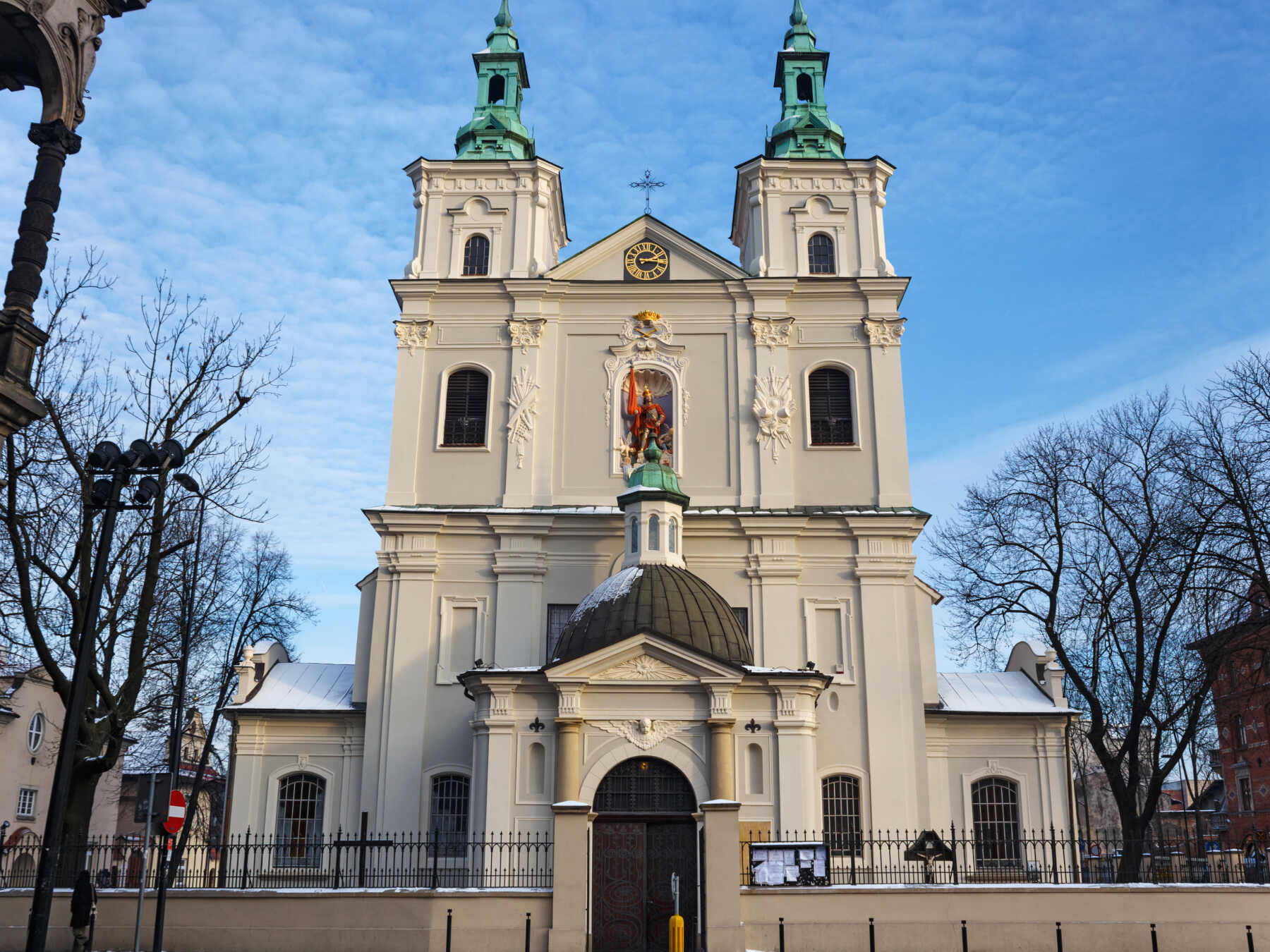
The church dates back to the 12th century, originally built to house the relics of St. Florian, a Roman martyr and patron saint of firefighters. According to legend, his relics were miraculously transported to the site in 1184.
In the Middle Ages, there was debate over which church should serve as the primary religious center of Kraków. Some Kraków burghers wanted St. Florian’s to be the main city church rather than St. Mary's Basilica in the Market Square. However, St. Mary's ultimately took that role, and St. Florian’s retained its importance as a pilgrimage site. We will visit St. Mary’s later in the tour today.
The church has undergone numerous renovations over the centuries. Today, it showcases a blend of Romanesque, Gothic, and Baroque architectural styles, with its most notable Baroque redesign occurring in the 17th century.
St. Florian's Basilica is one of Kraków’s most important churches, historically serving as the starting point for the royal funeral processions to Wawel Cathedral. It was also a key location for Karol Wojtyła (later Pope John Paul II), who served as a parish priest there before becoming the Archbishop of Kraków. He introduced modern pastoral methods, including youth ministry and academic discussions, which later shaped his leadership as pope. His time here deeply influenced his approach to engaging with young people and intellectuals.
The church houses beautiful frescoes, an ornate altar, and several chapels, including one dedicated to St. Florian. It also has a richly decorated organ loft and stained-glass windows that enhance its spiritual atmosphere.
Today, the Basilica remains an active parish church and a popular pilgrimage site, attracting visitors interested in both religious and historical aspects of Kraków.
Turn right onto Jana Matejki Street and we will make our way towards Old Town.
Read More
plac Jana Matejki 11, 31-157 Kraków, Poland
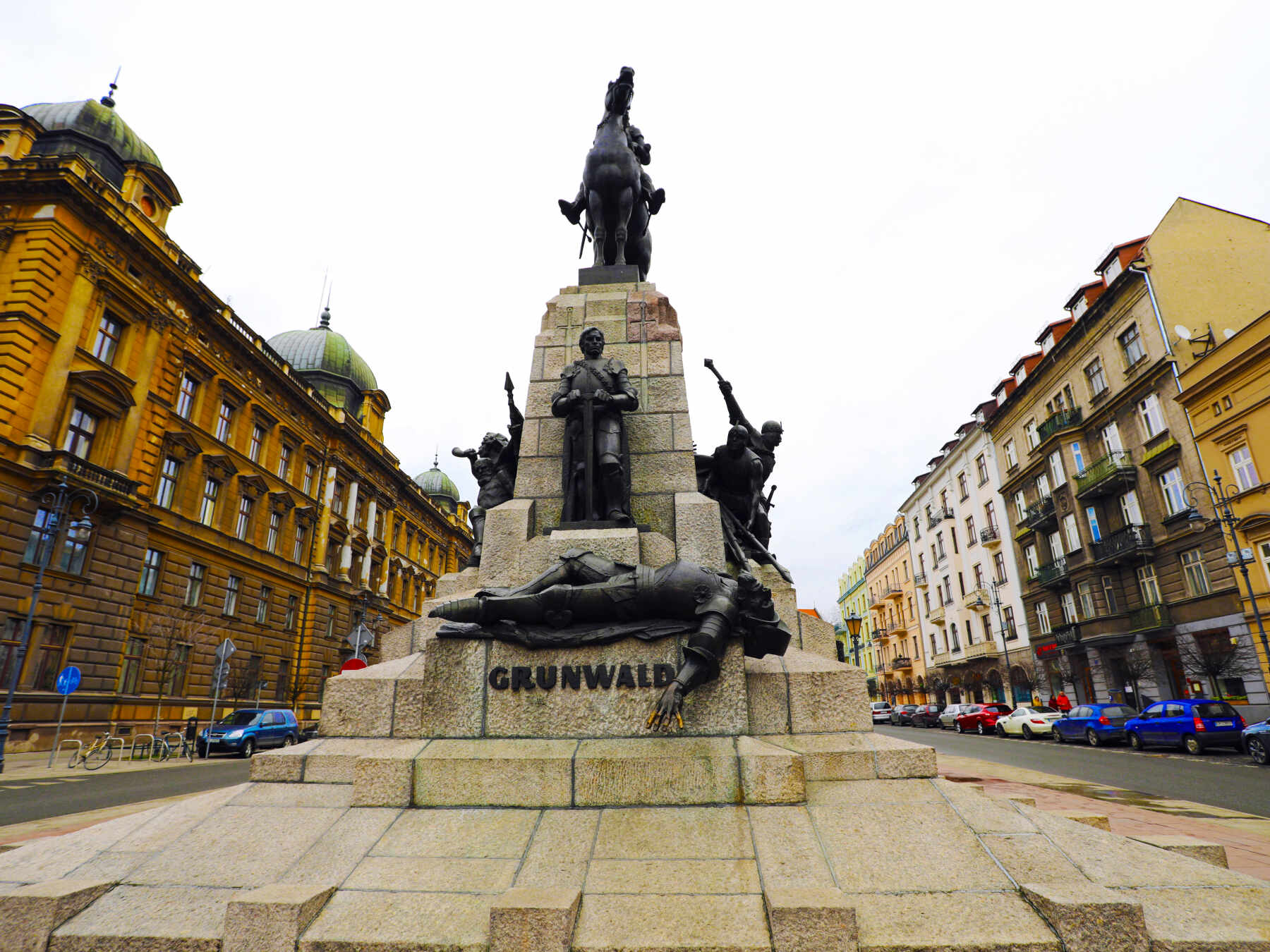
In 1882, the square was named in honor of Jan Matejko, a distinguished Polish painter renowned for his depictions of significant historical events. A prominent feature of the square is the Grunwald Monument, unveiled in 1910 to commemorate the 500th anniversary of the Battle of Grunwald, a pivotal victory for Polish and Lithuanian forces over the Teutonic Knights. The monument was funded by the esteemed pianist and politician Ignacy Jan Paderewski.
The monument stands 24 meters tall and features an equestrian statue of King Władysław II Jagiełło holding a sword. Below him, Grand Duke Vytautas of Lithuania is depicted, with the fallen Grand Master of the Teutonic Knights, Ulrich von Jungingen, at his feet. Additional figures include Polish and Lithuanian warriors and a peasant breaking free from bondage, symbolizing the broader impact of the victory.
During World War II, the monument was destroyed by Nazi forces in 1939 as part of efforts to erase Polish national symbols. Post-war, a reconstruction committee led by artist Marian Konieczny used surviving materials and historical records to rebuild the monument, culminating in its re-unveiling on October 16, 1976.
Adjacent to the square, on your right, is the Jan Matejko Academy of Fine Arts, the oldest fine arts academy in Poland, established in 1818 and named after Matejko in recognition of his contributions to Polish art and culture.
The square also hosts the Tomb of the Unknown Soldier, honoring unidentified Polish soldiers who died in combat.
Straight ahead we go to the Barbican.
Read More
Place 1
Basilica Floriana
Place 2
Grunwald Monument
Place 3
Barbican
Place 4
St. Florian's Gate
Place 5
Old Town
Place 6
Jama Michailaka Cafe
Place 7
Cuisine
Place 8
St. Mary's Basilica
Place 9
Market Square
Place 10
Bracka Street
Place 11
Nowa Prowincja Café
Place 12
The Basilica of St. Francis of Assisi
Place 13
Tram System
Place 14
Józef Diet Statue
Place 15
Schindler's List
Place 16
The Archaeological Museum
Place 17
Mary Magdalene Square
Place 18
The Church of Saints Peter and Paul
Place 19
Story Time
Place 20
St. Giles’ Church
Place 21
Wawel Castle
Place 22
Tadeusz Kościuszko Statue
Place 23
Main Gate
Place 24
Vasa Gate
Place 25
Wawel Cathedral and Pope John Paul II Statue
Place 26
The Wawel Vicars' House
Place 27
Courtyard
Place 28
Borka House and St. George's Church
Place 29
Thieves Tower
Place 30
The Dragon's Den
Place 31
Vistula River
Place 32
The Dragon Statue