

San Francisco Walking Tour, California - Chinatown, Historic and Spiritual sites (Self-Guided / GPS Audio Tour)
Places: 17 POIs
Distance: 1.37 mi
Duration: 1h:01m
GPS-guided narration through
Your Smartphone
Tour #1529
About this English self-guided 1h:01m walking tour in San Francisco
Welcome to the Historic America & UCPlaces audio walking tour of San Francisco's Chinatown. This tour will guide you through one of the Bay Area’s most celebrated neighborhoods, the oldest and biggest Chinatown in the United States. Using historic sites, spiritual institutions, sites, sounds and statuary, you’ll learn how this place has persevered as an iconic center for the Chinese diaspora. We can’t wait to share San Francisco's Chinatown with you!
To get started, meet me at the exit of the Montgomery Bart station, on Market Street.
- 1For the best experience, begin at the tour's recommended starting point and follow the stops in order.
- 2Want to start somewhere else? Simply use Start At on the tour screen, before tapping Start Tour, to begin from any stop.
- 3Need to detour or skip a stop along the way? Tap Tour Assistant (
![UCPlaces AI Bot Icon]() ) to use Force Play, Skip, and Back, for full flexibility.
 ) to use Force Play, Skip, and Back, for full flexibility.
Route Preview
- Category
- Language
- Mode
- Region
- Country
- City

Places (POIs) visited during this tour
Place #1
![Map Pin]()
Recommended Starting Point
Distance: 0.94mi
, Attraction : Start of Tour

572 Market St, San Francisco, CA 94104, USA
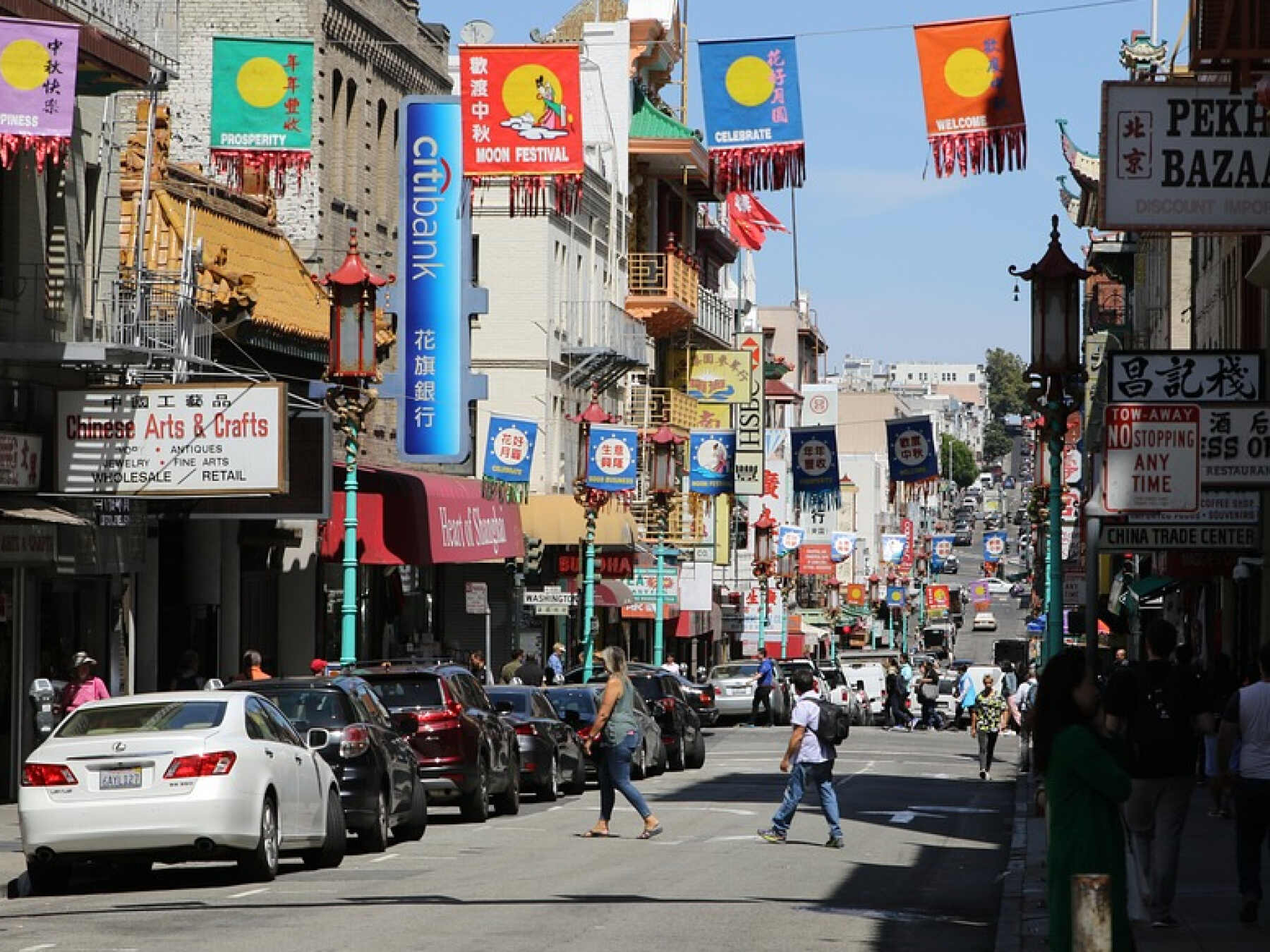
Chinatown's History
Welcome to Historic America & UCPlaces’ audio walking tour of Chinatown. We’re glad you could join us! I’m Rachel, Professional History Nerd.
On today’s tour, I will guide you through one of San Francisco's most celebrated neighborhoods and introduce you to the many hallowed institutions and historic buildings that have served the local community for almost 200 years.
We’re beginning here near the Bart station at Montgomery, but we’re making our way to the iconic gate that marks entry to Chinatown. Use the built in navigation to get to the gate, and I’ll narrate a bit of history along the way.
We’re about to step into a world of vibrant colors, sounds, sights, and smells that will immediately transport you a world away. While there are several distinct Chinese neighborhoods in San Francisco, the oldest, and largest Chinatown is right here in the heart of downtown.
The earliest Chinese immigrants to the Bay Area came in the 1840s, just before the Gold Rush. This young city on a hill was often referred to as “Gold Mountain,” and just as fortune seekers hurried west across the Great Plains, the Chinese crossed an ocean. Initially welcomed, by 1854, anti-Chinese sentiment pushed the local government to segregate the Chinese residents. Legislation soon restricted the Chinese to reside only in the area around Dupont Street, now Grant Street. At the time, the Chinese population was overwhelmingly male. 12,000 men and fewer than ten women lived in the city! In the 1850s, most of the immigrants worked as miners and prospectors in gold country. By the 1860s, many became laborers working to build the transcontinental railroad. These workers sent the little they earned back to their families in China. In those days, Chinatown was mostly self governing, relying on its own institutions to help settle immigrants and resolve disputes. The community built its own temples, churches, hospitals, and schools. Chinatown was also home to Chinese language newspapers that fought back against anti-Chinese sentiments.
Chinatown also had a darkside. At a time prostitution was rampant, the Chinatown-based Tong Gang trafficked hundreds of women from China to San Francisco as enslaved sex workers. Non-Chineese often traveled to Chinatown to patronize both brothels and gambling dens. The 1870s was a time of economic hardship throughout San Francisco, and the Chinese community emerged as scapegoats. Moral panic spread throughout San Francisco, alleging that prostitutes in Chinatown were responsible for spreading venereal disease. In 1877, a riot broke out in Chinatown that left four migrants dead. And in 1882, the Chinese Exclusion Act barred almost all new immigration from China. This cruel act permanently cut many of the immigrants in Chinatown off from their families. In 1900, Bubonic Plague broke out in Chinatown and the public health officials' ruthless response also took a toll on the Chinese community. When the 1906 Earthquake shook San Francisco, Chinatown was all but obliterated. The city government conspired to move Chinatown to the fringes of the city but the empress of China intervened and, fearing a loss of trade with China, the city council agreed to rebuild the rubble of Chinatown. On today’s tour, you will see what rose from those ashes. A neighborhood built by fortune seekers, sustained through unimaginable hardship, and endured to its modern role as a center for the Chinese diaspora, Chinatown’s history is both a tragic and triumphant tapestry. We will explore the ways in which the people of Chinatown built a new community, while maintaining connection to homeland.
Chinatown is both a thriving local neighborhood and a beloved destination for travelers. As the oldest Chinatown in North America and the largest Chinese settlement outside of Asia, it receives more annual visitors than the Golden Gate Bridge! It’s the most densely populated area of the United States, outside of Manhattan, and about seven times more dense than the San Francisco neighborhood. Despite San Francisco’s rapid gentrification in recent decades, Chinatown’s population remains over 90% Chinese-American. Very few residents are fluent in English. Chinatown is not a wealthy neighborhood. Many families who live here live below the poverty line. Those who improve their circumstances often move out of Chinatown to other parts of San Francisco or the surrounding cities. The median age among Chinatown’s residents is 50, higher than in any other neighborhood in the city. As we walk through the hustle and bustle, you may feel as if you’d stepped off a plane and landed in Hong Kong. If it weren’t for the towering Transamerica Building to the east or views of Coit Tower farther north, you might forget that you’re in San Francisco at all.
Now that I’ve set the stage, let's enter the gate!
Read More
Place #2
![Map Pin]()
Distance: 0.22mi
, Attraction : Famous Gate
500 Bush St, San Francisco, CA 94108, USA
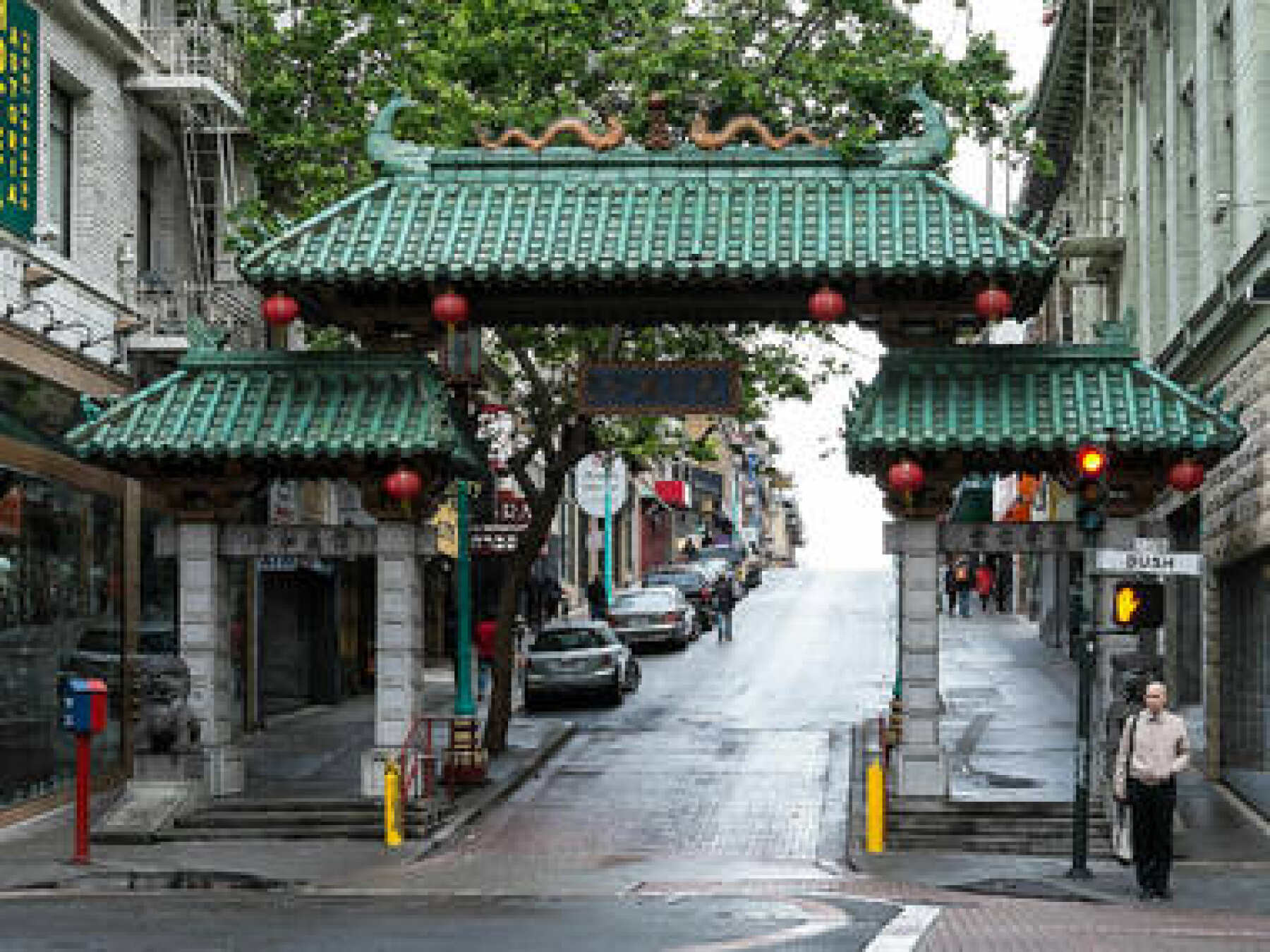
The Dragon Gate
The ornate gate before you marks your entrance to Chinatown.
The gate was erected in 1969 as a gift from Taiwan in an effort to improve diplomatic relations with the US. Since then, it has come to epitomize the unique character of San Francisco's Chinatown. Built mainly in Taiwan and covered in beautiful Taiwanese tiles, the Dragon Gate stands as a beacon welcoming visitors under its archways. Designed by Clayton Lee and a team of Chinese American architects, the Dragon Gate is one of the most spectacular and certainly the most authentic of all American Chinatown gates, drawing inspiration from ceremonial gates common in Chinese villages. This gate is built of stone which, while traditional in China, is rare in American Chinatowns where the gates are often made from wood. Notice the supports are flanked by ceremonial guardian lions. The lion on the left is male and has its paw perched on a pearl, a traditional symbol of the Chinese Empire. The lion on the left is female and guards a baby lion symbolizing the people of Chinatown. The top of the gate is decorated with dragons representing power and fertility and the fish represent prosperity. Between the dragons is a ball which represents the earth. A sign written in Chinese hangs above each of the three portals of the gate. The middle sign reads “All under heaven is for the good of the people,” a motto of the Chinese freedom fighter Sun Yat-sen. We’ll learn more about him at a later stop. The left sign reads “respect and love” and the right reads “trust and peace.” The gate is one of the most photographed places in San Francisco, so make sure to snap a selfie before we embark on our exploration of this iconic neighborhood.
When you’re ready, pass through the Chinatown gate and take in Grant Avenue, formerly Dupont Street. This block, once the center of San Francisco’s red light district, is now a great place for tourists to grab kitschy souvenirs and inexpensive t-shirts. Peek into the shops as we continue up Grant for one block. I'll meet you at the intersection of Grant Ave. and Pine St. We’re headed to take in the statuary of St Mary’s Square.
Read More
Tour itinerary stops | Additional places you'll see on this self-guided tour
Place 1
Chinatown's History
Place 2
The Dragon Gate
Place 3
St Mary's Square
Place 4
Comfort Women Column of Strength
Place 5
Statue of Sun Yat-sen
Place 6
California Street Cable Car
Place 7
Old Saint Mary's Cathedral
Place 8
Nam Kue School
Place 9
Eastern Bakery
Place 10
Portsmouth Square
Place 11
Buddha's Universal Church
Place 12
Bank of Canton/Old Chinese Telephone Exchange
Place 13
Tin How Temple
Place 14
Presbyterian Church-Chinatown
Place 15
Chinese United Methodist Church
Place 16
Directions to Ross Alley
Place 17
Ross Alley
Click below for full access to this tour
Have any questions about this tour? Or a general travel / self-guided tours question? That's completely natural
+ How long does this tour take?
Most travelers complete this tour in approximately 1 to 1 hours, depending on pace, time spent at each stop, and optional detours. Having said that, please remember that self-guided tours are extremly flexible (you can start, pause, continue anytime) and everyone has their own pace.
+ What does this tour include?
This self-guided walking tour includes 17 stops, covering top attractions such as Chinatown's History, The Dragon Gate, St Mary's Square, Comfort Women Column of Strength, Statue of Sun Yat-sen.
+ Where does the tour start?
The tour starts at Chinatown's History (Address: 572 Market St, San Francisco, CA 94104, USA). You can begin the tour there or join from any stop along the route.
+ What type of tour is this?
This is a self-guided walking tour designed to be completed on foot through walkable areas and city highlights.
+ Can I do this tour at my own pace?
Yes, this is a self-guided walking tour, so you can start anytime and explore at your own pace. You can pause, skip stops, or spend more time at places that interest you. You can even split it into multiple days. Explore however feels right for you.
+ Is this a walkable tour?
Yes, this tour is fully walkable and designed to follow a comfortable route through pedestrian-friendly areas.
+ Do I need anything in order to take the tour?
There is one thing that you need - A mobile phone (with the UCPlaces app installed and active location services, and a cellular data plan with a decent signal for downloading the tour) and comfortable walking shoes! But here are some recommendations for a great experience: 1. Make sure your phone is fully charged and bring a mobile charger/battery. 2. Bring earphones for the best experience. 3. Bring a bottle of water and dress appropriately according to the weather forecast.
+ How will I navigate from point to point during the tour?
The tour uses GPS-based navigation through the UCPlaces app, with automatic audio playback and step-by-step directions between stops. Just follow the route (cross streets carefully using crosswalks) and listen to the audio guide. Use the resume feature to continue the from where you recently stopped (or closed the app). Easily skip or go back to stops.
+ Is this tour suitable for families or groups?
Yes, self-guided tours are ideal for families and small groups, allowing everyone to explore comfortably without being tied to a fixed schedule.
+ What makes a self-guided tour better than a guided tour?
Self-guided tours are more flexible, affordable, and personalized. You can avoid crowds, choose your pace, and focus on the stops that interest you most.
+ I installed the app and it's now asking for GPS and media access permissions, why?
The app is your tour-guide, it needs to know where you are located on the map to be able to trigger the points of interest. It also needs access to audio and media files to provide you with this experience.
+ What happens if there are unexpected roadblocks or navigation issues?
We have been working hard to deliver a great experience. Though you may run into unexpected obstacles (the world is constantly changing), our app has multiple features and mechanisms in place to help you overcome them, including: AI assistance, force play an audio if you can't reach the stop, skip or return to stops, automatic rerouting and more.
+ Can I take the tour in my language?
Though all of our tours are primarily in English, many tours are muyltilingual (including: Spanish, German, Portuguese, French, Japanese, Hebrew, French, Arabic and more...). The tour language options depend on the specific tour - You can easily check which languages are available in the tour screen!