

Huntsville Self-Guided (GPS) Audio Driving Tour, Alabama - Historic Churches
About this English self-guided 26m driving tour in Huntsville
Hello, and Welcome to this UCPlaces tour of Huntsville’s most historic houses of worship.
My name is Stephen, and I’m excited to show you around town today!. Before we get started, I’d like to take a minute to introduce the sponsor of today’s tour, our local expert Realtor Steve Stinson.
Steve is a lifelong Alabamian and a 40+ year Madison County, Alabama inhabitant, and his love for the area shows in the knowledge, expertise, and passion he provides his clients.
If you live or are considering living, in the Madison County area you are blessed. This area includes Huntsville, Madison, Hampton Cove, and Owens Cross Roads, Alabama. The rolling hills, valleys, lakes, and streams create some of the most beautiful sights in Alabama. Madison County is perfectly situated at the southern end of the Appalachian mountain chain and is surrounded by all forms of natural wonder. The cost of living is among the lowest in the country and you won’t find nicer people anywhere!
When you’re ready to make your next move in Madison County, give Steve a call at 256-652-2316 or send him an email at stevestinson@kw.com.
All right! Let’s get started with the tour. Our first stop today is home to one of the state of Alabama’s oldest congregations. Follow your GPS directions to St. Bartley Primitive Baptist Church.
- 1For the best experience, begin at the tour's recommended starting point and follow the stops in order.
- 2Want to start somewhere else? Simply use Start At on the tour screen, before tapping Start Tour, to begin from any stop.
- 3Need to detour or skip a stop along the way? Tap Tour Assistant (
![UCPlaces AI Bot Icon]() ) to use Force Play, Skip, and Back, for full flexibility.
) to use Force Play, Skip, and Back, for full flexibility.
 ) to use Force Play, Skip, and Back, for full flexibility.
Route Preview
- Category
- Language
- Mode
- Region
- Country
- City

UCPlacer level Expert
Last updated Feb 3, 2026
Ask agent to contact you
Places (POIs) visited during this tour

3107 Love Ave NW, Huntsville, AL 35816, USA

St Bartley has the oldest Black congregation in the state of Alabama, tracing its roots back to graveyard gatherings as early as 1808. The church’s official beginning was in 1820 when construction was begun on the original church near Big Spring, downtown.
Throughout their first fifty years, the African Huntsville Church, its name at the time, was influential in the greater religious community. It was a member of the Flint River Association, a group of both black and white churches that sought religious unity in the Tennessee Valley region.
The original church building was burned down during the Union occupation of Huntsville at the end of the Civil War. When the dust settled, a new building was erected, and the congregation was renamed after their second pastor, Bartley Harris, who performed over 3,000 baptisms in Big Spring over the course of his career.
The second church, built in 1872, stood across Church Street from Big Spring until 1964, when it was forced to move to make way for new urban planning. Today, the site of the second church is part of Big Spring Park, a larger planned area that includes the Huntsville Museum of Art, City Hall, and the Von Braun Center.
St Bartley’s roots are easy to trace – the congregation has only had nine pastors in its 200 years of service. Today the church is known for its dedication to community service and family ministry.
Next up on our list, we’ll visit First Baptist, another 1960’s building with a far older congregation.
Read More
603 Governors Dr SW, Huntsville, AL 35801, USA
The current building is massive, with multiple expansions throughout the years adding to its size. The original structure, including the arched sanctuary, was built in 1963. The mural that adorns its side is officially called Cosmic Christ, depicting Jesus as a force encompassing the planets and stars. Locals, however, have taken to calling it “Eggbeater Jesus”, remarking that the figure’s abstract body resembles a whisk or wire mixer rather than the Holy Ghost.
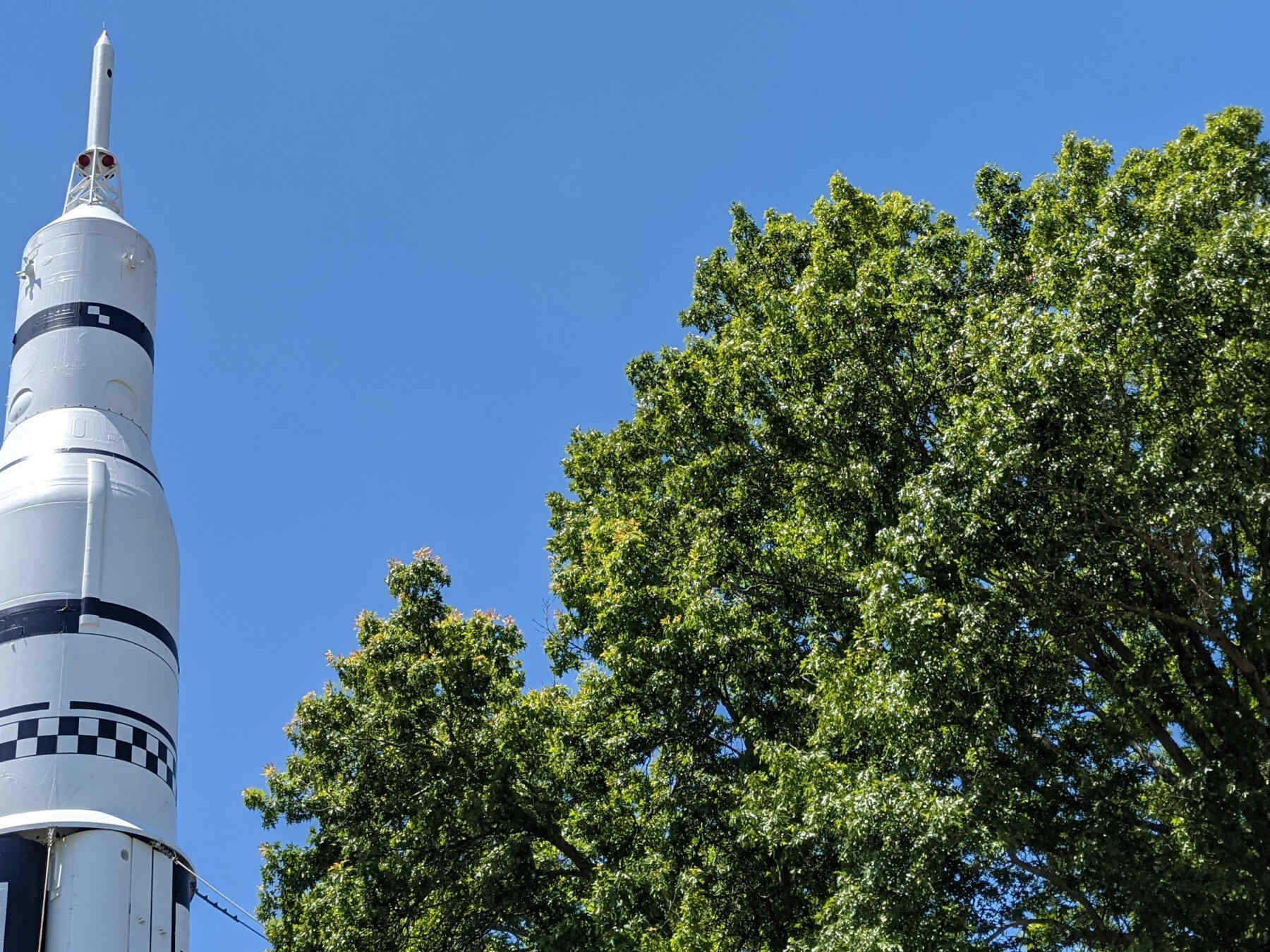
The mural was designed and constructed over the course of six years, from 1966 to 1973, during the height of the Apollo space program. Huntsville is home to the Marshall Space Flight Center, where rocketeering legend Wernher von Braun helped design the Saturn V vehicles that put man on the moon. The mural and the rocket-shaped campanile that was added later are an homage to Huntsville’s role in the space race.
The congregation that became First Baptist was organized on June 3, 1809, as the Flint River Church’s westernmost branch. Under that name, the church gathered in two meetinghouses, built in 1813 and 1825, in Meridianville to the north. The congregation moved to Huntsville in 1861 and settled on this site over a hundred years later.
With its towering stature and its proximity to major roads, the Huntsville Hospital complex, and the Big Spring area, First Baptist is a striking landmark that’s hard to miss and even harder to forget.
Up ahead, we’ll make a left on Madison Street and head up into downtown Huntsville, where we’ll find most of the historic buildings on our list.
Read More
Place 1
St Bartley Primitive Baptist
Place 2
First Baptist
Place 3
First Presbyterian
Place 4
Church of the Nativity
Place 5
Central Presbyterian
Place 6
Temple B'nai Sholom
Place 7
First Methodist and Randolph Church of Christ
Place 8
St Mary of the Visitation
Place 9
Holmes Street United Methodist Church