

Rome: Power, Sin & Secrets — Self-Guided Walking Tour from Campo de’ Fiori to the Pantheon
About this English self-guided 1h:02m walking tour in Rome
Welcome to a place that pretends to be lighthearted.
Campo de’ Fiori.
A square that today feels almost frivolous: the smell of warm bread, young people sitting on the ground, glasses resting on low walls, a constant hum of voices mingling with the scent of flowers... and fried food.
A square that smiles. A square full of life.
But Rome has a way all its own of telling stories: it shows you the surface... and then whispers in your ear everything that surface is hiding.
Today, we are going to walk through that very subtext. The shadowed side, the part you cannot see.
Campo de’ Fiori has no church, no basilica, no bell tower to give you your bearings. It is the only great square in the historic center without a sacred place watching over it.
And do you know why? Because the sacred was not needed here.
Here, justice did the talking.
A justice that was often just another name for power.
Here, in this space that now holds raised glasses and laughter, for centuries they set up temporary courts, public trials, sentences, punishments.
And at the center of it all, there was one element that always returns in the history of Roman power: fire.
Not a domestic fire, not a fire that warms. A fire that punishes. A fire that silences. A fire that sends a message.
You did not come here to seek salvation. You came here to watch someone burn.
If you close your eyes for a moment, you can almost picture the crowd pressed together, the overlapping voices, the waiting, that tension that comes before ritual violence... and wood creaking beneath a torch.
And in the middle of all this, there was a man.
A man who would not kneel. A man who did not know how to keep silent.
And he is where this journey begins.
Get ready, because what you are about to hear is not a history lesson. It is an immersion. A descent into the way Rome, in every century, has used sin, fear, beauty, and faith... to hold on to power.
When you are ready, take a step forward. Walk toward the dark statue that dominates the square.
That is where the story begins.
- 1For the best experience, begin at the tour's recommended starting point and follow the stops in order.
- 2Want to start somewhere else? Simply use Start At on the tour screen, before tapping Start Tour, to begin from any stop.
- 3Need to detour or skip a stop along the way? Tap Tour Assistant (
![UCPlaces AI Bot Icon]() ) to use Force Play, Skip, and Back, for full flexibility.
) to use Force Play, Skip, and Back, for full flexibility.
 ) to use Force Play, Skip, and Back, for full flexibility.
Route Preview

Places (POIs) visited during this tour

Monumento a Giordano Bruno, Campo de' Fiori, 33, 00186 Roma RM, Italy
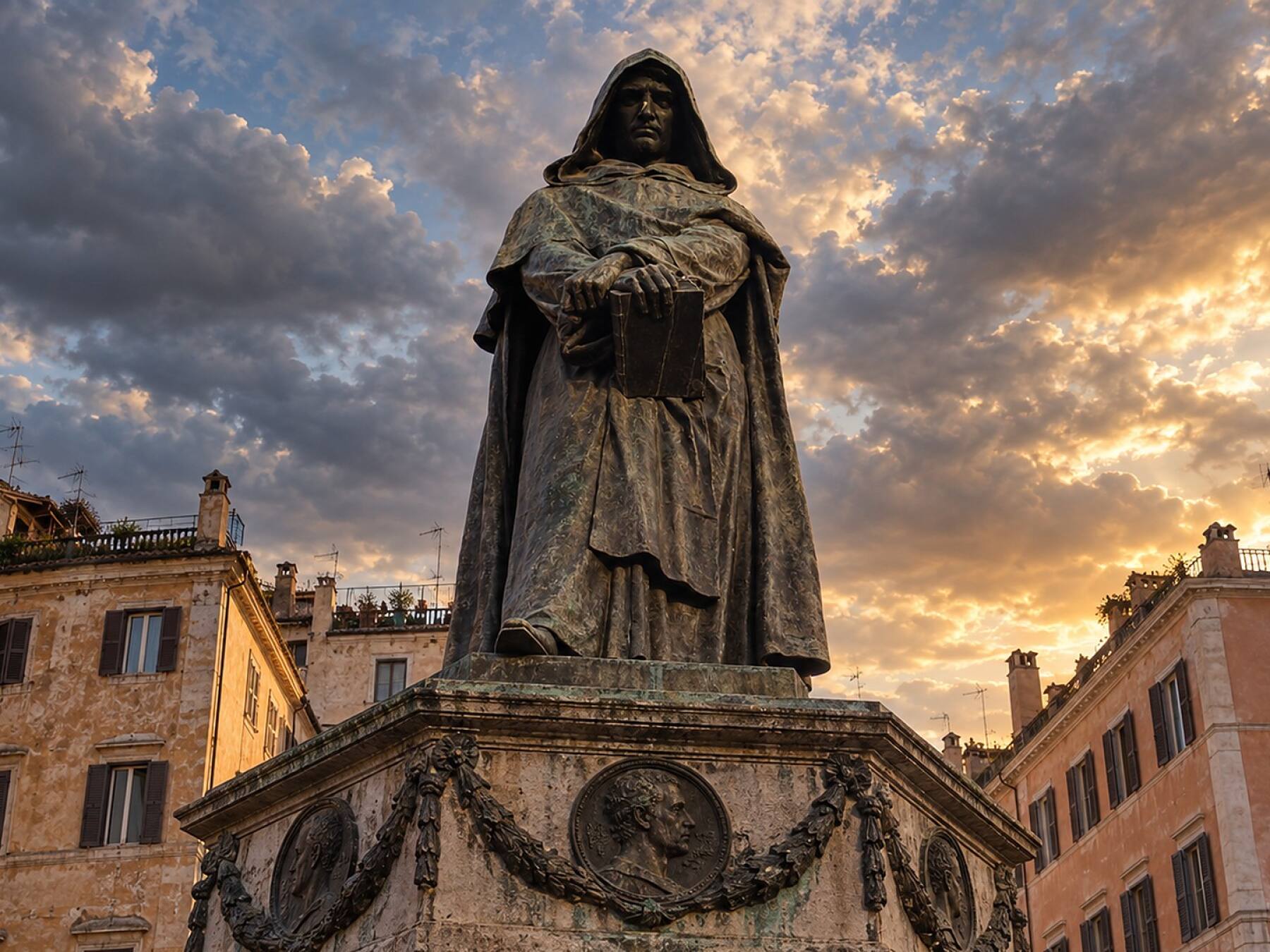
The hooded figure that looms over the square. The heavy robe, the hidden hands, the gaze fixed on infinity.
It is Giordano Bruno. But what you see is only his shadow.
The real story cuts deeper.
Bruno was not just a rebellious monk. He was a man trying to tell the world something the world was not ready to hear:
that the universe was not closed, small, and orderly like a courtyard.
It was infinite. Filled with worlds. Filled, perhaps, with other forms of life.
He rejected the finite Ptolemaic-Aristotelian cosmos, insisting that if God is infinite, then the universe must be infinite too, with no center and no boundaries.
He proposed the existence of infinite suns and infinite habitable worlds, all animated by the same vital energy.
He fiercely attacked ignorance, superstition, and the religious institutions that stood in the way of true knowledge and freedom.
He had to be SILENCED… but let’s understand the context.
For us, it almost sounds obvious: Netflix has more aliens than Italian series.
But in 1600, this idea was an atomic bomb exploding beneath Scripture.
And Bruno did nothing to soften the message.
He traveled across Europe like a spark in a storm: Geneva, Paris, London… everywhere he went, he stirred enthusiasm, anger, chaos. He talked too much, challenged everyone, and never held his tongue.
A man like that, in the wrong century, could only end up where you are now: at the foot of a stake.
They arrest him in Venice. They take him to Rome. They interrogate him for seven years.
Seven years. Seven years.
Seven years in which, every single day, someone tried to make him yield. To make him say, “I was wrong.”
But Bruno… Bruno was not a man who surrendered.
Legend has it that when they read him the death sentence, he replied:
“Perhaps you tremble more in pronouncing it than I do in hearing it.”
That line lands like a punch in the face of history.
And so, on the morning of 17 February 1600, they bring him here.
Picture the scene: – the biting cold, – the crowd pressed together, – the wood piled high, – the soldiers keeping people back, – and Bruno with an iron gag clamped in his mouth, to stop him from speaking.
Because they knew that if he had been able to speak… he would have set minds on fire.
The flames rise.
First the smoke. Then the crackling. Then the heat.
Do not imagine a neat bonfire. It was torture.
They were not punishing a criminal. They were trying to extinguish an idea.
Or at least, they were trying.
And look at the square now.
People drink, talk, take pictures.
The square is lively. It has lost its smell of smoke.
But the city does not forget.
Rome never erases its inconvenient history: it puts on a mask. But underneath… everything remains.
And that monument, the one in front of you, is not a tribute to the victim. It is a warning to power.
Ideas do not burn. Not with all the wood in the world.
Now let go of Bruno’s image.
The next stop will take you into the house of noble power, the elegant kind, built on silent rooms and weighty family names.
Read More
Via Dei Baullari, 41, 00186 Roma RM, Italy
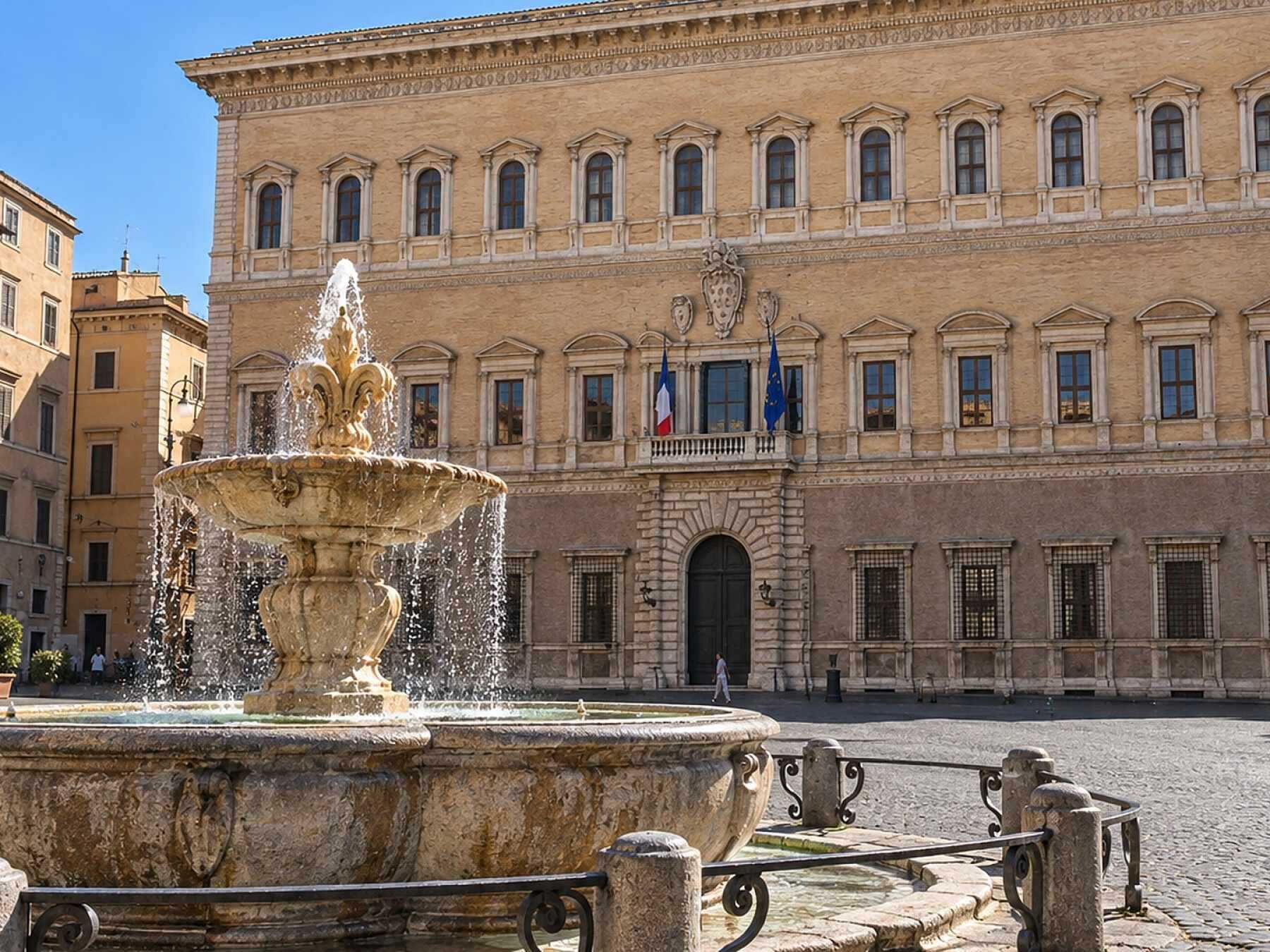
Look straight ahead.
Palazzo Farnese is not just a palace. It is a message in stone, a warning, a monument to one simple idea:
“Power is not requested. It is displayed.”
When Alessandro Farnese — the future Pope Paul III — decided to build it, he did not want a home.
He wanted a throne.
And not just any throne: one that would dominate an entire square, that would speak before anyone even stepped inside, that would say to Rome, to those arriving from Naples, from Florence, from all across Europe:
“If you come to me... know exactly who you are dealing with.”
The façade is perfect. Clean lines, identical windows, proportions composed like a musical score.
But do not be deceived by the calm.
Within these walls, alliances were forged, betrayals set in motion, marriages arranged at a table, careers created out of nothing.
Alessandro Farnese had illegitimate children. Many of them.
And instead of hiding them, he used them as pieces on a chessboard.
One becomes a cardinal. Another, a duke.
Nepotism? Here, it was elevated into an art form.
When he ascended to the papal throne as Paul III, the palace was no longer just a symbol of his family... it had become an antenna broadcasting power.
Step into this scene in your mind: imagine the palace lit by torches, carriages arriving, French envoys knocking at the door in the middle of the night, messengers running with sealed letters.
Every window, a story. Every light, an agreement. Every room... a secret.
Ah, and then there are the fountains in the square.
Do you see those enormous basins? They were not born here.
The Farnese took them — without asking permission — from the Baths of Caracalla, several kilometers away.
They had them dragged here through the city.
Why?
For the same reason people buy luxury cars or collectors’ watches today: to show everyone how far you can go... or how much weight you can move.
In Rome, if you can move a piece of history, you can move anything: people, consensus, destinies.
And this palace proclaims it without moving a muscle.
Look at the windows. Imagine shadows in discussion, cardinals arguing, ambassadors shaking hands with false smiles.
Here, more than anywhere else, you understand that real power is never loud.
Real power is the kind that does not need to shout, because it has already won before it speaks.
When you are ready, let your gaze drift toward the next square. The next stop will take you to a place where power is not hidden inside rooms... but carved in plain sight for all to see.
Read More
Place 1
Giordano Bruno Monument
Place 2
Piazza Farnese
Place 3
Piazza Navona
Place 4
Bramante Cloister
Place 5
San Luigi dei Francesi
Place 6
Temple of Hadrian
Place 7
Trevi Fountain
Place 8
Lovers' Fountain
Place 9
Sant'Ignazio
Place 10
Pantheon
Place 11
Pantheon (Epilogue)