
Many of us have watched Waymo robotaxis quietly roaming city streets, picking up passengers with no one behind the wheel. It's an impressive sight, and it's easy to come away thinking that autonomous driving has essentially been solved.
The reality is a bit more nuanced. Autonomous vehicles have made extraordinary progress, but companies are still working through difficult edge cases such as severe weather, construction zones, and other complex driving situations before the technology can scale everywhere. Even so, the trajectory is becoming increasingly clear. Over the next few years, autonomous vehicles are likely to move beyond today's limited deployments into much broader commercial operations.
When that happens, the industry's biggest challenge will begin to change.
For the past decade, nearly every conversation about autonomous vehicles has centered on the same question: Can the car drive itself safely? It's the question that deserves to be answered first, and billions of dollars have been invested to answer it. But once autonomous driving becomes reliable enough to operate at scale, a different question emerges—one that may ultimately prove just as important: What should passengers do while the car is driving?. That may sound like a surprisingly simple question, but it has profound implications.
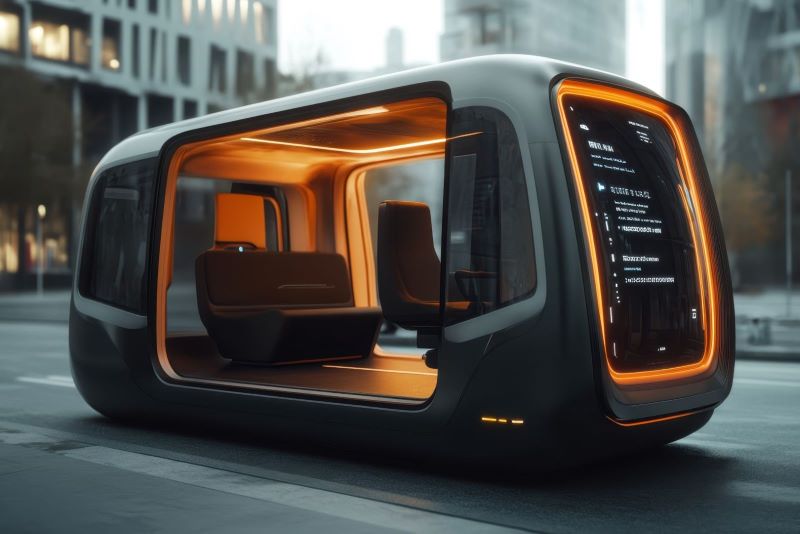
For more than a century, the automobile has existed for one primary purpose: transportation. Whether driving ourselves or sitting in the back of a taxi, we have always viewed the journey as something to complete as efficiently as possible. The destination mattered; the trip itself rarely did.
Autonomous vehicles change that equation entirely.
For the first time in automotive history, every passenger becomes available. Instead of concentrating on traffic, directions, and the vehicle around them, people are suddenly free to spend their time however they choose. They can answer emails, watch a movie, read a book, or simply look out the window. In other words, autonomous vehicles don't just eliminate the driver, they create an audience.
History tells us that whenever a new technology frees people from one activity, entirely new markets emerge around what they do instead. Smartphones didn't simply replace telephones; they created app stores, mobile banking, ride sharing, food delivery, and countless industries that barely existed beforehand. The internet didn't merely digitize newspapers; it fundamentally changed how people communicate, shop, learn, and entertain themselves.
Autonomous vehicles are likely to follow the same pattern.
Imagine arriving in San Francisco after a long flight. As your robotaxi pulls up to the curb, it asks a simple question: "Would you like the fastest route to your hotel, or would you like to spend the next hour discovering the city?"
Suddenly, the ride is no longer just transportation.
Instead of driving directly downtown, the vehicle crosses the Golden Gate Bridge, climbs into the Presidio, stops at scenic overlooks, passes through North Beach and Chinatown, and glides along the Embarcadero. As each landmark approaches, professionally produced narration begins automatically, telling the stories that transformed ordinary streets into places of significance. The passenger doesn't need to search for anything, book a tour, or follow a guide waving a flag. The city simply introduces itself, one neighborhood at a time.
What's remarkable is that almost every piece of technology required to create this experience already exists. Autonomous driving systems continue to improve. Navigation systems know exactly where vehicles are located. Artificial intelligence can personalize interactions and adapt to passenger preferences. High-quality GPS-triggered content has been around for years. What's missing isn't the technology. It's recognizing that autonomous vehicles don't have to be limited to transportation.
Today, robotaxi companies understandably compete on safety, reliability, cost per mile, fleet utilization, and geographic expansion. Those are the metrics that matter while the technology is still maturing. But eventually, those capabilities will become expected rather than exceptional. Just as airlines no longer compete on their ability to keep airplanes in the sky, autonomous vehicle companies won't compete indefinitely on whether the car can complete a safe left turn. Those capabilities will become the baseline.
The next competitive frontier is likely to be passenger experience.
Tourism is perhaps the clearest example. Every day, millions of travelers arrive in unfamiliar cities with several hours to spare before checking into a hotel or boarding a flight home. Today, transportation gets them to their destination. Tomorrow, it could become the destination. Instead of offering only an airport transfer, autonomous mobility providers could offer architecture tours, historic city drives, food experiences, movie location tours, wine trails, or scenic routes—all delivered by the very same vehicle that would otherwise have taken the shortest path to the hotel.
But the opportunity extends well beyond tourism. Families on road trips, people relocating to a new city, business travelers with an unexpected free afternoon, and even local residents exploring their own communities could all benefit from vehicles that understand not only where they are going, but what is worth experiencing along the way.
In many ways, autonomous vehicles already possess the one capability that no human tour guide ever could. They know precisely where they are, where they have been, and what passengers are approaching. They can introduce a historic building at the exact moment it comes into view, explain the significance of a neighborhood while driving through it, or tell the story behind a monument before passengers even realize it's there. Instead of simply navigating roads, autonomous vehicles could eventually interpret the world outside their windows.
Perhaps that's the real opportunity waiting beyond autonomous driving.
The industry's first decade has been devoted to teaching cars how to drive. The next decade may be devoted to teaching them how to create experiences.
Because once the car learns how to drive, transportation is no longer the only product it can deliver.
The journey itself becomes part of the destination.